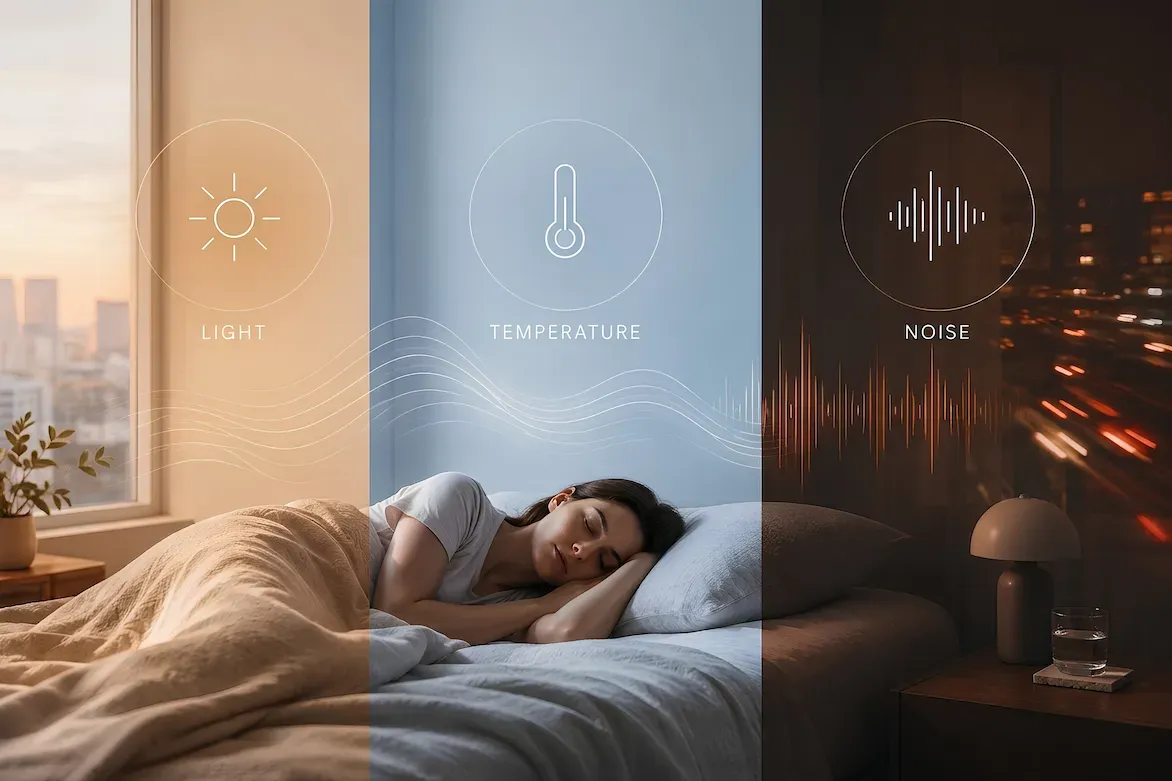
Of all the sleep advice in circulation, this is the one with an actual number attached, which is probably why it spread. Set your bedroom to around 65 degrees Fahrenheit, roughly 18 Celsius, and sleep better.
It’s a good starting point. It’s also easy to misread, mostly because people treat it as a target for how the room should feel rather than what it should do.
Here’s what’s actually going on, and how to find your own number.
Your Body Has to Lose Heat to Fall Asleep
Sleep doesn’t begin with your eyes closing. It begins with your temperature falling.
In the hour or two before sleep, your core body temperature starts to drop, and that drop is one of the signals your brain reads as the day ending. It isn’t a side effect of getting sleepy. It’s part of the mechanism.
To lower your core temperature, your body moves heat outward and sheds it, mostly through the parts with the most surface area and the least insulation: your hands, your feet, and your face. Blood flow to the extremities increases, they get warmer, and heat leaves.
This is why warm feet often help people fall asleep, which sounds backwards until you realize warm feet are the sign that heat is successfully leaving.
Why a Warm Room Is Worse Than a Cold One
A room that’s too warm interferes directly with that process. There’s nowhere for the heat to go. Your body keeps trying, you stay warmer than you should be, and sleep onset drags.
Being too cold is a problem too, but a different one. It’s less likely to stop you falling asleep and more likely to wake you later, particularly in the second half of the night.
That asymmetry is why the standard advice errs cool. Given a choice between slightly too cool and slightly too warm, cool interferes with less.
What the 65 Actually Is
A starting point drawn from mainstream guidance, not a law, and not your number.
Treat it as the first setting to test rather than the setting to achieve. The right temperature varies between people, and it varies for the same person depending on bedding, sleepwear, humidity, and who else is in the bed.
Humidity in particular gets ignored. Shedding heat depends partly on moisture evaporating from your skin. In a humid room that works less well, so the same reading on the thermostat feels considerably warmer. If your bedroom is humid, you’ll likely need it cooler than the number suggests.
The Setup Most People Get Wrong
The instinct when you’re cold is to warm the room. Usually the better move is the opposite: cool room, warmer bedding.
Air temperature is what lets your body dump heat. Bedding is what keeps your skin comfortable. Those are two separate controls and they don’t need to move together. A cool room with a warm duvet gives you both. A warm room with a thin sheet gives you neither.
The related trick: let your feet out. Feet are one of the main heat exits. Uncovering them, or letting them stick out of the duvet, is a fast and free adjustment, and it’s why people do it without knowing why.
Getting the Timing Right
Cool the room before you get in it, not once you’re already lying there being too warm.
Your temperature is supposed to be falling in the run-up to sleep. A room that only starts cooling at midnight is arriving late to a process that began at ten.
If you have a programmable thermostat, that’s the setting worth adjusting: start the cooling before bedtime, not at it.
A warm bath or shower an hour or so before bed works on the same mechanism, and it’s the other thing that sounds backwards. Warming your skin increases blood flow to the surface, and when you get out, the heat leaves quickly. The net effect is a faster drop, not a rise.
How to Find Your Own Number
Change one thing and give it time.
Pick a setting. Keep it for at least four nights, because a single night tells you almost nothing and you’ll be tempted to conclude something from it anyway.
Judge it on two things: how long it takes you to fall asleep, and whether you wake in the second half of the night. Those are the two failure modes, and they point in opposite directions. Slow to fall asleep and kicking off covers suggests too warm. Waking at 4 a.m. and pulling covers back suggests too cold.
Then adjust by a degree or two and repeat. You may land somewhere near the standard advice, or several degrees away, and the second outcome is a legitimate result rather than a failure to comply.
If You Can’t Control the Thermostat
Plenty of people can’t, in shared housing, rentals, or a building with communal heating. The mechanism still gives you levers.
Move air rather than cooling it. A fan doesn’t lower the room temperature much but it speeds evaporation from your skin, which is most of what you’re after.
Change the bedding rather than the room. Lighter layers you can adjust in the night beat one heavy layer you can only have on or off.
Uncover the heat exits. Feet out, arms out, and don’t sleep with your head under anything.
And handle the daytime: keeping the sun off the windows during the day does more for a hot bedroom at night than anything you can do at 11 p.m.
The Short Version
The number is a starting point, and the mechanism behind it is the part worth remembering: your body has to shed heat to fall asleep, and a warm room stops it.
Cool the room before bed, keep the bedding warm, let your feet out, and test one setting for several nights before deciding. Your number may not be 65, and that’s fine. Knowing why the rule exists is what lets you find the one that’s actually yours.