You know you’re a light sleeper. That part you’ve figured out. What you haven’t figured out is what to actually do about it, because the internet hands you a list of twenty fixes and no sense of which one matters.
So here’s a ranking. Not of which disruptor is worst in some abstract sense, but of which one is most likely to be wrecking your night right now, and which one gives you the most back for the least effort.
First, Why Ranking Helps
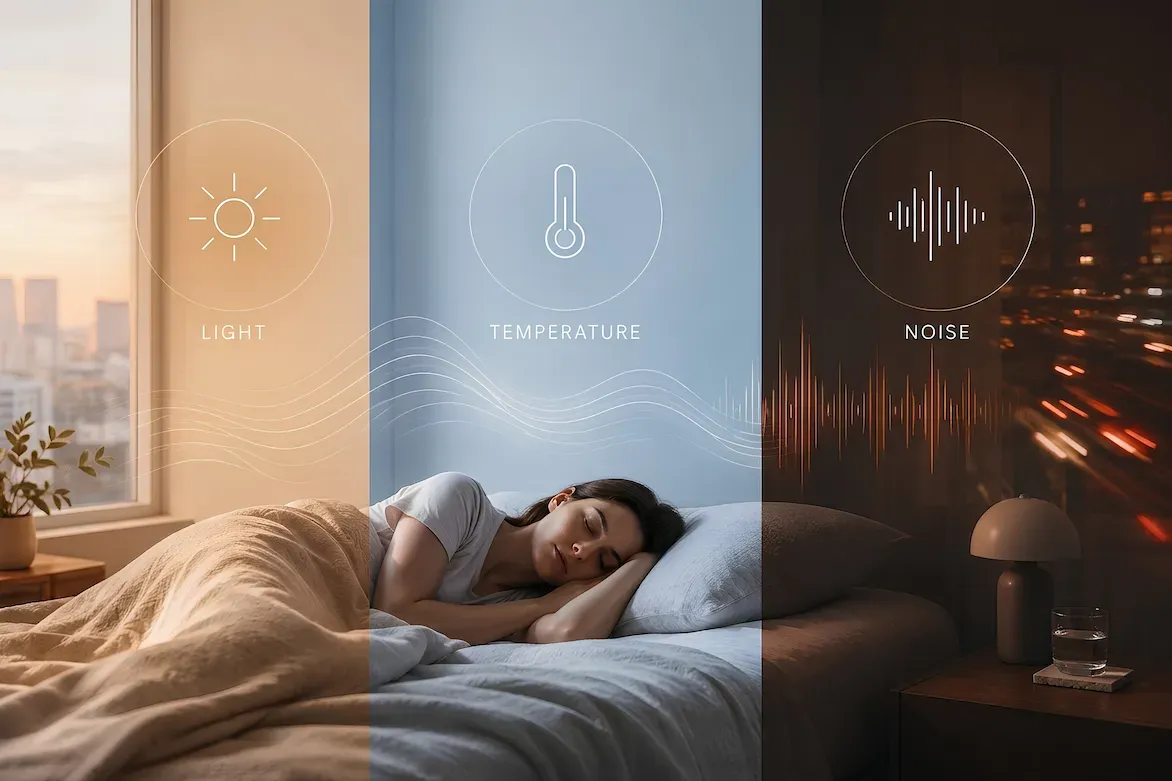
Light, noise, and temperature don’t disturb sleep the same way, and that difference is the whole point.
One of them mostly stops you falling asleep. One mostly breaks sleep you’ve already got. One quietly shifts what time your body thinks it is. If you treat all three as the same problem, you end up spending your energy on the wrong one, and then concluding that nothing works for you.
Something usually does work. It’s just rarely the thing you tried first.
1. Temperature: The One to Fix Tonight
Your body doesn’t drift off at a random moment. In the hour or two before sleep, your core temperature starts to fall, and that drop is one of the signals your brain reads as “we’re going down now.” To pull it off, your body has to shed heat, mostly through your hands, feet, and face.
A room that’s too warm blocks that. You’re not anxious, you’re not broken, you’re thermodynamically stuck. And unlike a noise you eventually tune out, you cannot get used to being too hot. Your body will keep trying to cool down all night, and you’ll keep surfacing.
This lands first for three reasons: you can’t adapt your way out of it, it acts on falling asleep rather than just staying asleep, and it’s usually free to fix.
What to do: aim for a cool room, somewhere in the mid-60s Fahrenheit as a starting point, and adjust from there. Cool the room before you get in it, not after you’re already lying there. Then let your hands and feet stay uncovered, since that’s where the heat actually leaves.
If you run cold and this sounds miserable, the trick isn’t a warm room, it’s a cool room and warmer bedding. You want the air cool and your skin comfortable. Those aren’t the same setting.
2. Noise: The One Stealing Sleep You Don’t Know You Lost
Noise is sneakier, because you can genuinely sleep through it and still lose out.
Sound doesn’t have to wake you fully to cost you something. It can pull you briefly up into a lighter stage of sleep, and you’ll have no memory of it in the morning. What you’ll have instead is a night that technically lasted eight hours and somehow didn’t count.
This is the disruptor most likely to be your problem if the complaint is “I slept fine but I feel like I didn’t.”
The pattern of sound matters more than the volume. A steady hum, a fan, traffic that never stops, tends to fade into the background. Sudden and irregular sound, a door, a dog, a partner shifting, a truck at 4 a.m., is what pulls you up, because the change is what registers.
What to do: work in this order.
- Stop it at the source. The rattling vent, the phone that isn’t fully silenced, the appliance that cycles on at 2 a.m. Boring, and often the whole fix.
- Soften the room. Soft surfaces absorb sound, hard ones bounce it. A rug, curtains, or anything textiled on a bare wall does more than people expect.
- Cover what’s left. If the noise comes from outside your control, steady low-level sound gives the sharp noises less contrast to stand out against. You’re not blocking the sound, you’re flattening the spikes.
Earplugs are the fallback when the noise isn’t yours to control, not the first move. Fix what you own first.
3. Light: The One That Matters More Than It Feels Like It Does
Light ranks third, and this is where we’ll be honest with you: third does not mean unimportant. It means slowest to pay off.
Light is your body clock’s main input. It’s how your brain knows what time it is, more than any clock does. Light at the wrong hour doesn’t just make it harder to fall asleep tonight, it nudges your whole sleep timing later, so tomorrow night is a little harder too.
That’s why it ranks below the other two for a quick win, and why it might matter most over a month. You won’t feel the fix in one night.
The part people get backwards: the light before bed usually matters more than the light during sleep. Bright evening light is telling your brain the day isn’t over. That’s a bigger lever than the streetlight bleeding around your curtain.
What to do: dim your space in the last hour or so before bed. Not off, just down, and lower rather than overhead where you can. Then handle what’s left in the room, the standby LEDs, the charger glow, the gap in the curtains. An eye mask is the fallback when the light isn’t coming from something you can switch off.
And get some real light in the morning, ideally outdoors, ideally early. It’s the other half of the same system, and it’s the half that’s easiest to skip.
How to Tell Which One Is Actually Yours
The ranking is a starting point, not a diagnosis. Your bedroom gets a vote. A quick way to narrow it down:
- Can’t fall asleep, feel restless and fidgety? Start with temperature.
- Fall asleep fine, wake repeatedly, or sleep “enough” and still feel flat? Start with noise.
- Sleep fine but keep drifting later, or feel groggy for an hour after waking? Start with light.
Change one thing. Give it three or four nights, because one bad night proves nothing. Then change the next.
The instinct when you’re tired is to fix everything at once, and the problem with that is you learn nothing. You end up with a colder, darker, quieter room and no idea which change did the work, which means you can’t repeat it and you can’t stop doing the parts that didn’t help.
If You Take One Thing
Start with temperature, because it’s the fastest to test and usually costs nothing. Then noise, then light.
And if you’ve genuinely worked through all three and sleep is still difficult most nights, or daytime tiredness is affecting how you function, that’s worth raising with a doctor or a sleep specialist. An environment you can fix and a sleep problem that needs a professional are two different things, and it’s fair to want to know which one you’ve got.


