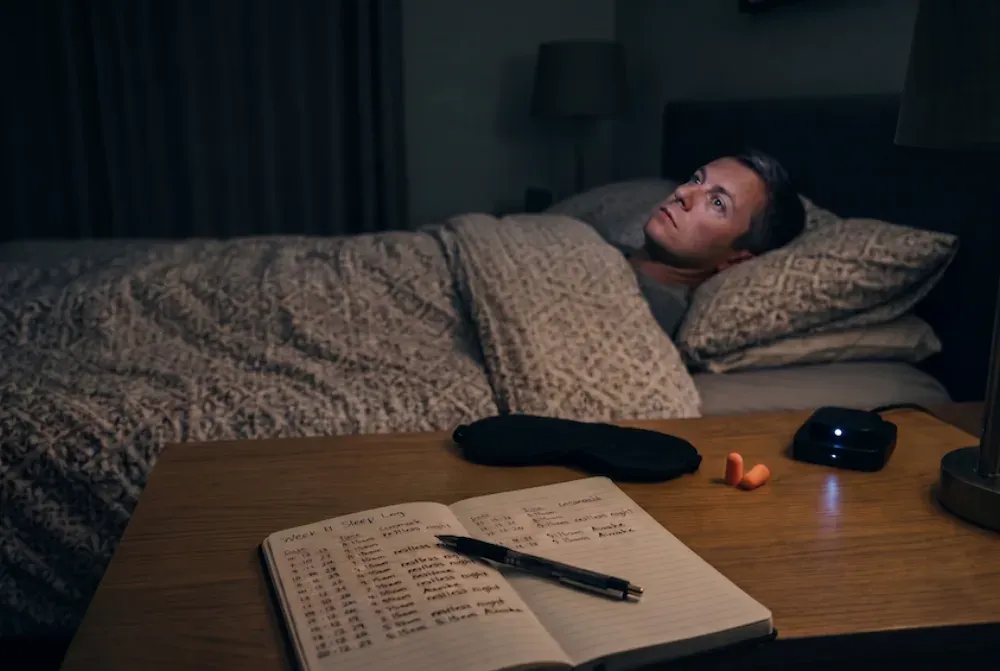
You’ve got the routine. Lights down, phone away, ten minutes of paying attention to your breathing while your brain runs through everything that happened since Tuesday.
And it doesn’t do much, which is confusing, because it’s supposed to.
Here’s the thing that usually explains it: bedtime is the hardest possible moment to start, and it’s usually the only moment it gets tried. Doing it during the day is easier, and it does more for your night.
Two Reasons Bedtime Is the Worst Time to Begin
You’re learning a skill at the moment you most need it to work. Nobody expects to learn to swim during a flood. Paying attention on purpose is a skill, it improves with repetition, and midnight with a full head is the least forgiving conditions available. If your only practice is at bedtime, you’re always practicing on hard mode.
The stakes are wrong. At bedtime there’s an outcome you want, which means you’ll be checking whether it’s working. Checking is a task, tasks require alertness, and the whole thing turns into another way to fail. At two in the afternoon there’s nothing riding on it, so you can actually do it.
There’s also a simpler point. By the time you lie down, a whole day of accumulated activation is already there. Ten minutes isn’t going to unwind twelve hours. Something that keeps the level lower all day works on the cause rather than the symptom.
What Daytime Practice Actually Means
Not sitting cross-legged for half an hour. Nothing you need to schedule, buy, or tell anyone about.
The unit is roughly one minute, and it’s the same instruction each time: pick something happening right now, pay attention to it, notice when your attention leaves, bring it back. That’s the whole exercise, and the noticing is the part that counts, not the staying.
Where to put those minutes matters more than how long they are.
Six Places to Put a Minute
The transition between things. After a meeting ends, before you open the next thing. Sit still, notice you’re breathing, count five breaths. This is the highest-value slot because transitions are where activation accumulates unnoticed.
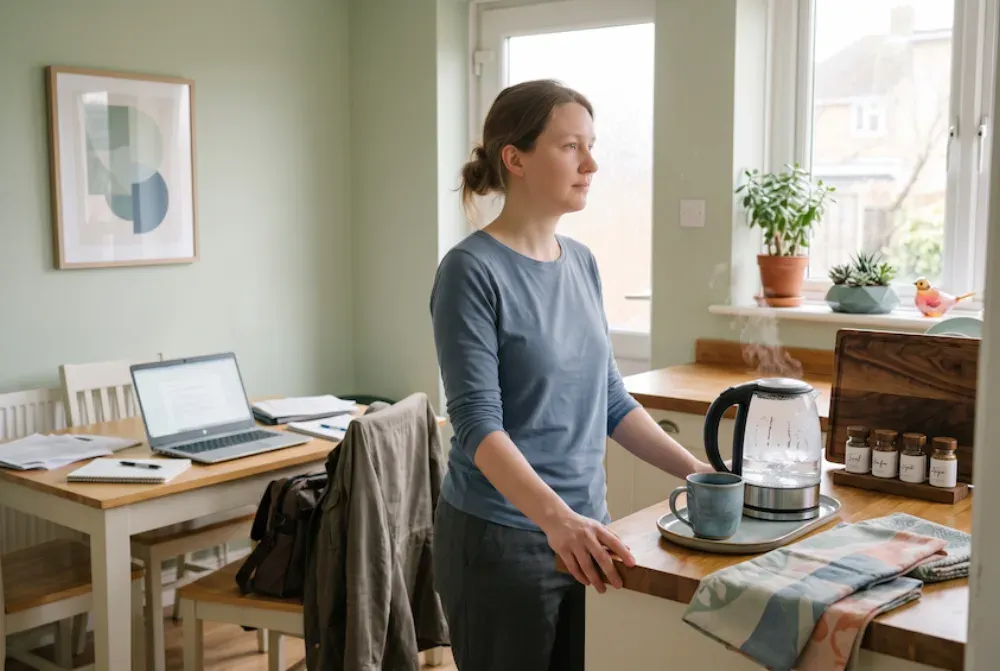
Waiting. The kettle, the lift, a queue, a loading screen. These already exist in your day as dead time, and they’re the easiest to convert because you’re not giving anything up.
One ordinary task, done with attention. Washing up, walking to the car, brushing your teeth. Pick one you do daily and pay attention to the physical parts of it. Water temperature, the weight of the mug, your feet on the ground. You’re not adding time to your day.
Before you eat. Ten seconds looking at the food before you start. It’s a natural pause point and it’s already there.
The commute home, if you have one. Not the whole thing, just the first few minutes, without a podcast. This one is particularly useful because it sits at the boundary between work and home, which is where a lot of evening activation gets carried across.
One deliberate stop mid-afternoon. Two minutes, sitting, doing nothing. This is the only one that costs you time, and it’s the one that most resembles what you’d do at bedtime, which is why it’s worth having.
Why This Helps at Night
Being honest about the mechanism, because the connection isn’t obvious.
You arrive at bedtime less wound up. Activation builds through a day and doesn’t discharge on its own just because you’ve stopped. Small interruptions through the day keep the total lower, so there’s less to come down from at eleven.
The skill is available when you need it. If you’ve noticed your attention wandering forty times during the day, doing it at midnight is familiar rather than novel. The technique works at bedtime largely to the extent that it’s already automatic.
You get better at noticing early. With practice you start catching the wound-up state at four in the afternoon rather than discovering it at midnight, and four in the afternoon is a much easier place to do something about it.
Bedtime stops being a test. When it’s something you do routinely, it carries less weight at night. That matters, because the weight is part of what keeps you awake.
Making It Stick
Attach it to something that already happens. After the kettle clicks. When you sit in the car. A cue that exists is worth more than an intention.
One minute, genuinely. The instinct is to make it ten and then skip it. One minute done daily beats ten minutes done twice.
Don’t track it. No streak, no app tally, no score. The moment it becomes something you can fail at, it joins the list of things generating pressure.
Missing days is fine. This isn’t a course with a completion rate. Three minutes a week is not nothing.
Expect it to feel pointless at first. It’s meant to be unremarkable. The effect is cumulative and mostly shows up as an absence, not being as wound up, rather than as anything you’d notice while doing it.
What This Isn’t
It isn’t a substitute for the basics. A steady wake time, morning light, and a cool room will each do more for your sleep than any amount of attention practice, and none of this replaces them.
It also isn’t for everyone. Some people find that turning attention inward makes them more anxious rather than less, and if that’s you, that’s real information rather than a reason to persist. Outward attention, on sounds or your surroundings, sometimes works where inward attention doesn’t. If neither does, this simply isn’t your tool, and plenty of others exist.
If sustained practice ever leaves you feeling unsettled or oddly detached from yourself, stop, and mention it to a doctor if it doesn’t pass.
When Something Else Is Going On
If you’re sleeping badly most nights over weeks, if you dread bedtime, or if daytime tiredness is affecting how you drive or work, that’s worth a conversation with a doctor rather than more practice. Persistent sleep difficulty has recognized approaches that work, and attention training isn’t a treatment for it.
Same if low mood or ongoing anxiety is part of the picture.
If You Take One Thing
The reason ten minutes of mindfulness at bedtime doesn’t do much is that it’s the first ten minutes you’ve done all day, at the hardest hour, with something riding on it.
Move it earlier and make it smaller. A minute after the kettle boils will do more for eleven o’clock than anything you attempt at eleven o’clock.