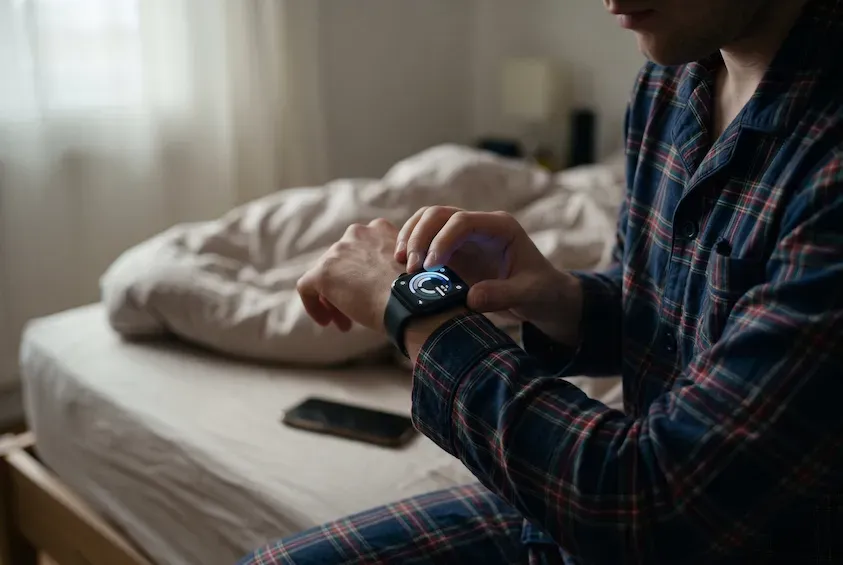
You want a number. Something to compare last night against, so you know whether to be pleased or concerned.
The honest answer is that a number wouldn’t help you, and chasing one will probably make your sleep worse rather than better.
That’s a frustrating thing to be told, so here’s why it’s true, and what to aim at instead.
Deep Sleep Isn’t a Dial You Have Access To
Start here, because everything else follows from it.
There is no technique that produces more deep sleep on demand. No routine, no supplement, no gadget, no breathing pattern. Your body decides how much you get, based on how long you sleep, how much you’ve been short recently, how old you are, and what you did during the day.
That allocation is not a weakness in the system. It’s the system working. Your body has considerably better information about what you need tonight than you do, and it acts on it automatically.
So “how much deep sleep should I get” is a bit like asking how much of your meal should be digested in the first hour. It’s not a quantity you’re in charge of.
The Priority System That Makes a Target Meaningless
Here’s the thing that makes chasing a number actively misleading.
When you’re short on sleep, your body doesn’t spread the shortfall evenly across the stages. It protects deep sleep first. Cut your night down and a larger share of what remains will be deep sleep, because that’s what gets defended.
Which produces a genuinely perverse result: a badly sleep-deprived night can show a higher proportion of deep sleep than a good one. If you were treating that proportion as a score, you’d read your worst night as your best.
The same works in reverse. After a stretch of good sleep, with no debt to repay, your body may allocate less deep sleep because it doesn’t need as much. Nothing is wrong. You’ve just stopped running a deficit.
A number that goes up when things get worse and down when things get better is not a number to optimize.
What Actually Determines How Much You Get
Four things, and only one of them is really under your control.
Total sleep. Deep sleep is a portion of a night. Short nights give you less of everything, and this is the lever that matters.
Recent sleep debt. Short yourself and your body increases the priority. Catch up and it relaxes.
Age. Deep sleep is abundant in childhood and declines gradually across a lifetime. This is ordinary, it comes with age, and it isn’t a decline to fight.
Physical exertion. Hard physical activity during the day tends to be followed by more of it.
Notice what isn’t on that list: anything you can do at bedtime.
The Target That Is Worth Having
Since the stage isn’t controllable, aim at the thing that is.
Enough total sleep for you, which you find by how you function rather than by a figure. Steady energy through the afternoon, waking without an alarm most days, not needing to catch up at the weekend. That’s the readout, and it’s more informative than any device.
A consistent wake time. More than anything else on this page. A stable schedule lets your body clock place the stages predictably, and it’s the single change most worth making.
Not cutting the night short at either end. You can’t rearrange the stages, only give them room.
Whatever’s interrupting you. A night that’s broken repeatedly loses depth even when the total looks fine, and that’s usually about the room or the evening rather than about you.
Alcohol, if it’s in the evening. It tends to suppress deep sleep early in the night, which is the one common, controllable input that does directly reduce it.
What About the Number on Your Watch?
Treat it as a rough impression rather than a measurement.
A wrist-worn device infers sleep stages from movement and heart rate. That’s a decent basis for estimating whether you were asleep and a considerably weaker one for estimating which stage you were in. Stage breakdowns are the least dependable thing these devices report.
Which means a low deep-sleep reading has two likely explanations before “my deep sleep is low,” and both are more probable: the estimate is off, or your body allocated correctly for a night when you didn’t need much.
There’s also a real trap here. Anxiety about a sleep score is itself bad for sleep, and it’s an increasingly common way for a device intended to help to make things worse. If your reading is affecting how you feel about a night you’d otherwise have described as fine, that’s a signal worth heeding.
When to Ask Someone
Persistent unrefreshing sleep is worth a conversation, and it’s worth having it about how you feel rather than about a figure.
If you’re getting a reasonable amount of sleep and remain exhausted during the day, if you snore loudly and habitually, if anyone has noticed you gasping or seeming to stop breathing during sleep, or if daytime sleepiness is affecting your driving or work, raise those with a doctor. Take your symptoms rather than your app screenshots; the symptoms are what’s useful.
The Honest Answer
You don’t need a deep-sleep target, because you have no way to hit one and your body is already managing the allocation better than a number would.
Get enough total sleep, keep your wake time steady, fix whatever is breaking up your nights, and let the stages sort themselves out. The measurement worth trusting is how you feel at four in the afternoon, not what your wrist reported at seven in the morning.


