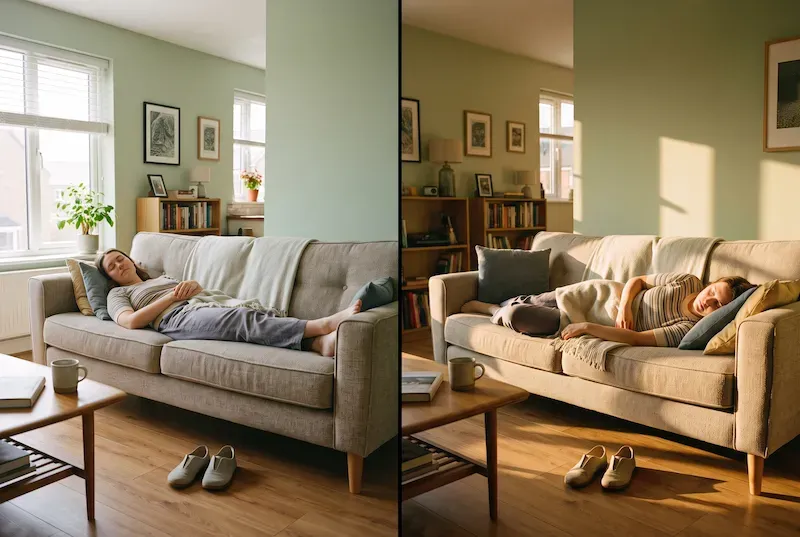
You had a nap on Sunday afternoon. You were awake at midnight, staring at the ceiling, doing the arithmetic and concluding that the nap did this to you.
Maybe. It’s a fair suspicion, and the mechanism behind it is real.
But “naps ruin your sleep” is too blunt to be useful, and if you’ve quietly banned yourself from ever lying down in daylight, you’ve probably given up something you didn’t need to.
The Myth: Naps Steal From the Night
Stated plainly, the belief goes: sleep is a fixed daily allowance, so any you spend in the afternoon is gone from tonight.
That’s not quite how it works, but it isn’t invented either. There’s a real thing underneath it, and it’s worth understanding rather than just being reassured about.
What’s Actually Going On: Sleep Pressure
From the moment you wake, a kind of pressure to sleep starts building. The longer you’re awake, the stronger it gets. By late evening it’s high, which is a large part of why you fall asleep at bedtime rather than lying there for hours.
Sleeping is what discharges that pressure. A full night discharges most of it, which is why you don’t feel sleepy at 8 a.m.
A nap discharges some of it too. That’s precisely why it works: less pressure means more alertness. And it’s also the honest basis of the worry, because pressure you spend at 4 p.m. isn’t available at 11 p.m.
So the answer isn’t “naps don’t affect your night.” They can. The useful question is when, and by how much.
The Three Things That Decide It
Length. A short nap discharges a small amount of pressure and you’ll usually never notice it at bedtime. A long one discharges considerably more. If you sleep 90 minutes in the afternoon and then can’t drop off at your usual hour, that isn’t mysterious.
Timing. This matters more than length, and it’s the one people get wrong. Pressure rebuilds across the rest of the day, so a nap at 1 p.m. leaves eight or nine hours to recover it. A nap at 6 p.m. leaves four, and the closer the nap sits to bedtime, the more directly it competes.
Whether you had pressure to spare. If you’re genuinely short on sleep, you’re carrying more than you need, and a short nap takes the edge off without touching what you need for tonight. If you’re sleeping well and napping out of habit, you’ve got less to give away.
Put together: a short nap early in the afternoon is unlikely to cost you anything. A long nap late in the day is the version that reliably does.
Two Cases Where the Advice Genuinely Flips
If you already have trouble falling asleep at night, naps are worth being much stricter about, and worth pausing entirely for a couple of weeks to see what changes. When falling asleep is the problem, sleep pressure is the main asset you have, and spending it during the day makes the evening harder. This is the situation the blanket “don’t nap” advice was built for, and for people in it, the advice is reasonable.
If you’re carrying a real shortfall, the calculus is the other way. Someone on broken nights, shift work, or a new baby isn’t at risk of having too little sleep pressure at bedtime. Refusing a nap on principle in that situation is choosing to be less functional today for a benefit tonight that probably wasn’t at risk.
Neither extreme describes an ordinary week, which is why one blanket rule doesn’t fit.
How to Tell Whether Your Naps Are Costing You
Run it as an experiment rather than a theory, because your recollection of last Tuesday isn’t reliable enough to conclude anything.
Keep naps short and early for two weeks: around 20 minutes, before mid-afternoon. Note roughly how long it takes you to fall asleep at night.
Then stop napping entirely for two weeks and note the same thing.
If falling asleep is clearly easier in the second stretch, your naps were part of it, and short-and-early is where to settle rather than nowhere. If there’s no real difference, the naps weren’t the problem, and you can stop policing them.
Two weeks each, because one night proves nothing and you’ll be tempted to conclude something from it anyway.
What to Do If a Nap Did Wreck Your Night
Don’t compensate. The instinct after a bad night is to go to bed early or nap longer the next day, and both push the pattern further out of shape.
Get up at your usual time, get bright light early, and let the pressure rebuild normally. One disrupted night sorts itself out in a day if you don’t chase it.
When It’s Worth Raising With Someone
If you need a nap every single day to function despite spending enough time in bed, if you’re falling asleep without meaning to, or if you can’t sleep at night regardless of whether you napped, that’s worth a conversation with a doctor.
A napping habit you can adjust and a sleep problem that needs looking at are different things, and it’s reasonable to want to know which one you have rather than experimenting indefinitely.
The Honest Answer
Naps can affect your night, and whether they do is mostly about length and timing rather than napping as such.
Short and early is the setting least likely to cost you anything. Long and late is the version that earns naps their bad reputation. And if falling asleep at night is already difficult for you, that’s the one case where cutting naps out for a while is genuinely worth trying.
What isn’t true is that resting in the daytime is inherently a mistake. It’s a tool with conditions attached, and the conditions are learnable.


