Almost every piece of sleep advice eventually points at the same thing. Get light in the morning. Dim the lights in the evening. It comes up so often it’s become background noise.
It keeps coming up because it’s the one input that sets everything else. Your sleep timing, your alertness curve, how hard mornings are: all of it is downstream of a system that runs on light, and once you can see the whole system rather than individual tips, the tips stop being arbitrary.
So here’s the whole thing in one place.
You Have a Clock, and It Runs Slightly Long
Your body has an internal clock that governs a great deal more than sleep. It sets when you get drowsy, when you’re sharp, when your temperature rises and falls, when digestion is most active, when certain hormones release.
Left entirely alone, in constant conditions, that clock doesn’t run to exactly 24 hours. It tends to run slightly long. Which means that without a daily correction, you’d drift steadily later, night after night.
That correction is light. Every day, light resets the clock to match the actual world. It is not a nice-to-have; it’s the mechanism that keeps you aligned at all.
This is also why sleep drifts later so easily and comes earlier so reluctantly. You’re not imagining that asymmetry. You’re feeling a clock that naturally runs long.
Your Eyes Do Two Different Jobs
The part that makes the rest make sense.
Vision is one job. There’s a second, separate system in your eyes whose only purpose is measuring light for the clock. It doesn’t produce images. It doesn’t need you to be looking at anything. It’s simply reporting how much light is around and what kind.
Two consequences follow.
It works whether or not you notice. You don’t have to look at the sky for morning light to count. Being outside is enough.
Closed eyes reduce light but don’t eliminate it. Light still reaches through your eyelids, which is why a bright room can affect you while you’re asleep and unaware of it.
Timing Beats Brightness
The single most useful principle here, and the one most advice skips.
The same light has opposite effects depending on when it arrives.
Light in the morning pulls your clock earlier. Sleepy earlier, awake earlier, easier mornings.
Light in the evening pushes your clock later. Awake later, harder mornings.
Light in the middle of the day does relatively little to your timing, though it helps alertness.
So there’s no such thing as “getting enough light” as a quantity. A great deal of light at eleven at night is actively working against you. It’s a timing input, not a nutrient.
The Thing Nobody Tells You About Brightness
Indoor lighting feels adequate because your vision adapts to it. The clock system doesn’t grade it the same way.
Daylight outdoors is dramatically brighter than a well-lit room, by a margin that’s easy to badly underestimate, and that holds true on an overcast day. An hour by a window is not equivalent to ten minutes outside.
This is why “get morning light” so often fails to produce anything. People do it indoors, conclude it doesn’t work, and stop. The instruction is really “go outside,” and the difference between the two is most of the effect.
The Practical Version
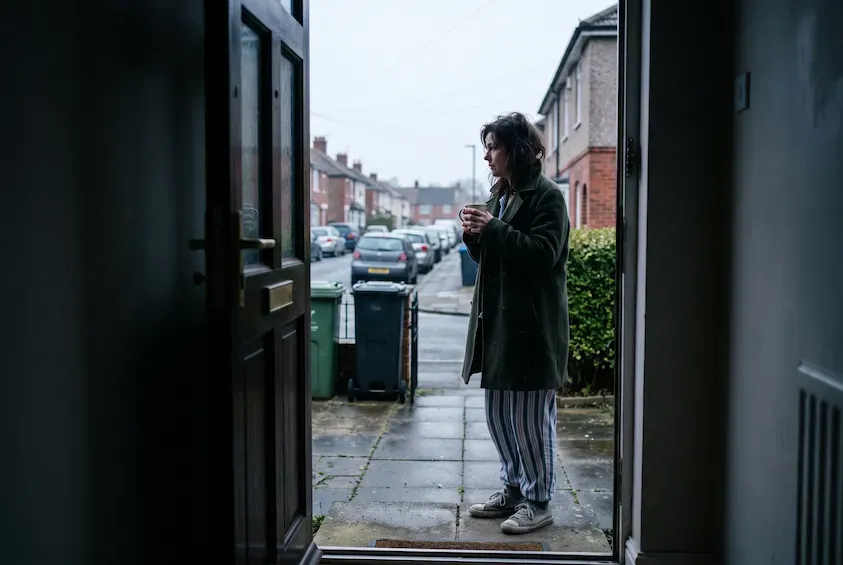
Get outside within an hour of waking. Ten or fifteen minutes. Coffee on a doorstep, the first part of a commute on foot, walking somewhere you’d have driven. It doesn’t have to be pleasant weather and you don’t have to enjoy it.
Do it at the same time each day. A consistent signal sets a stable clock. An erratic one doesn’t, however bright it is.
Keep getting daylight during the day if you can. It reinforces the contrast between day and night, and the contrast is what the system reads.
Dim the last hour or two. Lamps rather than overhead lights, lower rather than higher in the room. Dim everything, not just your screen: a kitchen ceiling light is usually doing more than a phone.
Keep the night dark. Light during sleep still registers even with your eyes shut. Standby lights, a lit hallway, the gap around a curtain.
Then open it all up as soon as you’re awake. Darkness for sleeping and brightness for waking are two halves of one lever, and the second half is the one people skip. A very dark bedroom with a dim morning after it can make waking harder rather than easier.
Why This Fixes Mornings Specifically
Grogginess in the first stretch after waking is normal and it fades on its own. Light is the fastest way to speed that up, and it works on two timescales at once.
Immediately: bright light shortens the fog on any given morning.
Over weeks: consistent morning light shifts your whole clock earlier, so your body starts the waking process before the alarm rather than being ambushed by it. That’s the version worth having, and it’s why the effect compounds.
Which is also why one week of morning walks doesn’t feel like much. Give it a fortnight before deciding.
When Light Isn’t Enough
If you’re outside every morning at a consistent time for a month and your timing hasn’t moved at all, that’s worth raising with a doctor rather than continuing alone.
Some patterns of shifted sleep timing are more than habit and respond better to structured guidance. Your natural timing may also simply be late, which is a normal variation rather than a fault, and worth understanding before you fight it.
If you’re in a place with very little winter daylight, or your mood drops noticeably in the darker months, that’s worth a conversation too. There are approaches for that and they’re worth getting right rather than improvising.
The Short Version
Your body clock runs slightly long, and light is the daily correction that keeps you in step with the world.
Morning light pulls you earlier. Evening light pushes you later. Outdoors is far brighter than indoors even under cloud, which is why the advice fails when people do it by a window.
Fifteen minutes outside, at the same time every morning. It’s the highest-return thing on any sleep list, it costs nothing, and it takes about two weeks to show you what it’s worth.


