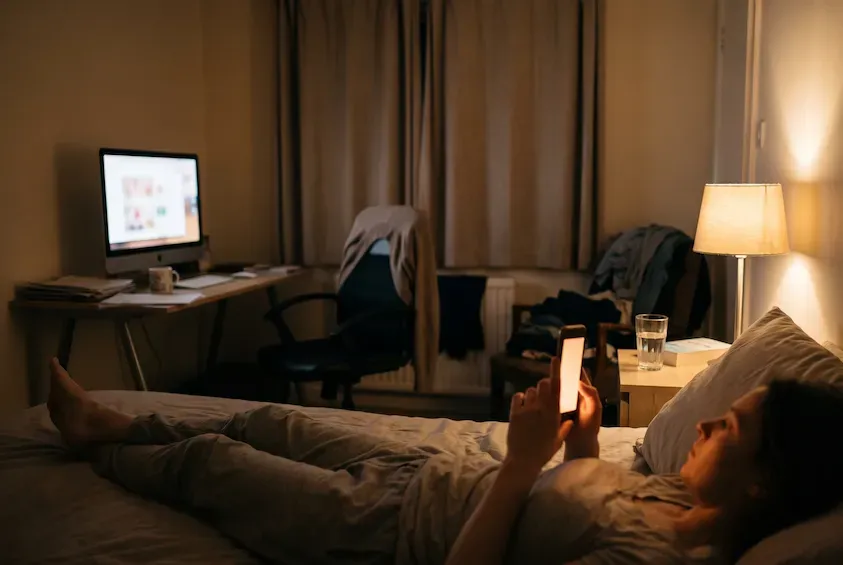
You know the advice. No screens before bed. You’ve heard it enough times that it’s stopped meaning anything, partly because it’s usually delivered as a flat prohibition by someone who doesn’t seem to understand that the evening is the only time you get.
So let’s do this differently. Not “screens are bad,” but what a screen in your bedroom actually costs you, which parts of that you can do something about, and which bits of the standard advice are overstated.
Because two quite different things are going on, and they don’t cost the same.
Cost One: The Light
Your body clock is set mainly by light. It reads what’s reaching your eyes and uses it to work out what time it is, and it’s more interested in the evening and the morning than in the middle of the day.
Light in the evening tells your clock the day isn’t over. That pushes your timing later, which makes falling asleep harder tonight and pushes tomorrow later too. It’s a small effect per evening and a cumulative one over weeks.
The part that gets misrepresented is the size of it. Evening light matters, and a screen is not usually the brightest thing in your evening. The ceiling light in your kitchen is likely doing more than your phone is, and nobody ever tells you to dim that.
So the useful version of the light advice isn’t “no screens.” It’s lower the overall light level in the last hour or two, of which the screen is one contributor among several.
Two things do make screens worse than their brightness suggests:
Distance. A phone 30 centimeters from your face delivers considerably more light to your eyes than a television across the room does, even though the television is a much bigger and brighter object. Proximity is doing more work here than screen size.
Duration and timing. Twenty minutes at nine o’clock is different from two hours ending at midnight. The closer to sleep and the longer the exposure, the more it counts.
Cost Two: The Stimulation, Which Is the Bigger One
Here’s what the light-focused version of this advice misses, and it’s the part that probably matters more for most evenings.
Falling asleep requires your system to be settled enough to let go. Not just sleepy: unactivated. And what’s on the screen is frequently doing the opposite of settling you.
A competitive match, a tense episode, a work message, an argument in a comment thread, a game you’re losing: each of these raises alertness, and the alertness outlasts the activity. Turning the screen off doesn’t switch off the state it produced. That’s why you can finish at eleven, lie down at ten past, and be wide awake with your heart still going.
This is the thing to reason about, because it explains why some screen time is nearly harmless and some ruins the night.
Passive, familiar, and finite is a mild version. Something you’ve seen before, that ends, that doesn’t ask anything of you.
Interactive, novel, and endless is the expensive version. Games with a next objective, feeds with no bottom, anything competitive, anything with notifications, anything involving other people’s opinions of you.
By that measure a rewatched episode of something comforting is a very different proposition from twenty minutes of scrolling, even though the second one is shorter and the screen is smaller.
The Third Cost Nobody Mentions
Screens are extremely good at making time disappear.
A show that autoplays the next episode, a game with one more level, a feed with no natural end: none of these have a stopping point built in, so the stopping decision has to come from you, at the exact hour when you’re least inclined to make good decisions about it.
For a lot of people this is the real cost. Not the light, not the arousal, but simply going to bed 70 minutes later than intended, several nights a week. That’s a large amount of lost sleep, and it’s caused by the format rather than the content.
What to Actually Do
Ranked by how much they give you for the effort.
Give it an ending. Pick the stopping point before you start: this episode, this match, this many minutes. Turn off autoplay. The single most useful change isn’t what you watch, it’s making it stop by itself.
Choose the calmer thing later in the evening. Save the competitive, tense, or work-adjacent stuff for earlier. Something familiar and undemanding for the last stretch. This isn’t about virtue, it’s about which state you arrive in bed in.
Dim everything, not just the screen. Lower the room lights in the last hour, lamps rather than overhead. If you’re dimming the phone while the ceiling light blazes, you’re solving the smaller half.
Put distance between you and it. A screen across the room is meaningfully gentler than one at arm’s length. If you’re going to watch something, watch it from further away.
Keep the phone out of the bed. This is the one worth being firm about, and it’s a different problem from the rest, deserving its own read. Face down and out of arm’s reach at minimum, another room ideally.
Deal with the standby lights. A television, console, or charger with a status light is a light source in a dark room all night, and it’s easy to miss because you stopped seeing it years ago. Turn the device so the light faces a wall, or unplug what doesn’t need to be on. The one thing never to cover or unplug is a smoke alarm or carbon monoxide detector.
What’s Overstated
Worth saying plainly, because overclaiming makes the whole subject easier to dismiss.
Watching something calm on a screen in the evening is not a catastrophe, and a rule that says otherwise will simply be ignored. The evening screen is, for a lot of people, the only genuinely restful part of the day, and treating it as a vice mostly generates guilt rather than sleep.
The costs are real and they’re specific: light adds up, activation lingers, and endless formats steal time. Address those three and you can keep the screen.
When It’s More Than Screens
If you’re doing all of the above and still lying awake, the screen probably wasn’t the problem.
And if you’re exhausted during the day despite enough time in bed, or sleep has been difficult most nights for weeks, that’s worth raising with a doctor rather than removing one more thing from your evening.
If You Take One Thing
The bedroom screen costs you three separate things: a bit of clock-shifting light, a lingering state of alertness, and a stopping decision you have to make at the worst possible hour.
Only one of those is about brightness. Fix the ending first.


