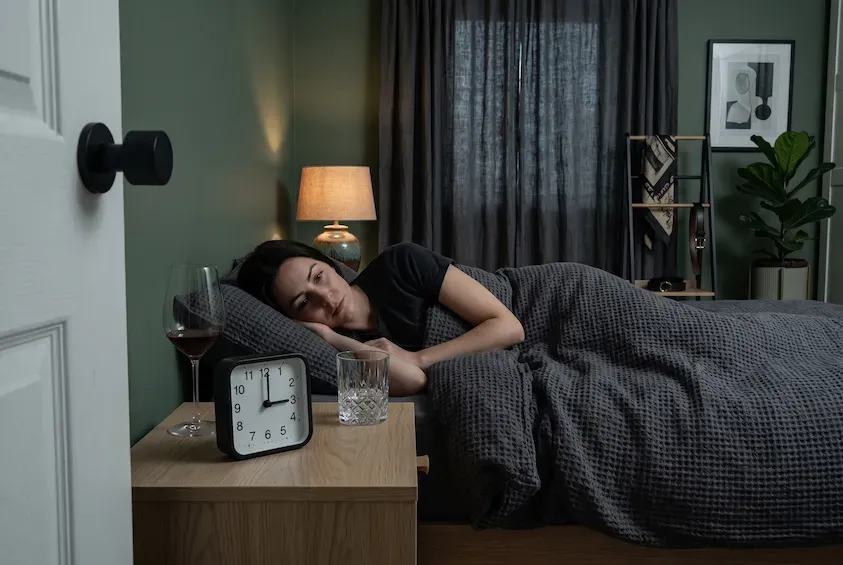
It’s oddly precise. Not “sometime in the night.” Around 3, give or take twenty minutes, most nights, with a consistency that starts to feel like it means something.
You lie there running through the possibilities. Stress. Age. Something medical. Something about 3 a.m. specifically.
The reassuring part first: waking in the night is a normal feature of how sleep runs, not a malfunction. The part worth understanding is why it lands at the same time, and why some people sail back to sleep while you’re awake for an hour.
Waking Up in the Night Is Standard
Sleep isn’t one continuous block. Across the night you cycle between lighter and deeper stages repeatedly, and at the boundaries between cycles you come very close to the surface.
Brief wakings at those boundaries are ordinary. What varies is whether you notice them. They’re usually forgotten within seconds, because nothing happened and nothing needed your attention.
So the honest framing isn’t “why am I waking up.” It’s “why am I noticing, and why can’t I get back down.”
Why the Second Half of the Night Is Different
Your sleep isn’t evenly distributed. The deepest sleep is concentrated in the earlier part of the night, and as the night goes on, the balance shifts toward lighter sleep and dreaming.
That means by the small hours you’re sleeping considerably closer to the surface than you were at midnight. The same brief surfacing that passed unnoticed at 12:30 is much more likely to tip into proper wakefulness at 3.
Two other things stack on top around then.
Your body is preparing for morning. Your clock starts the wake-up process well before you actually get up, and alertness begins ticking upward in the early hours. You’re not fighting the deepest part of the night; you’re waking during a rising slope.
Anything unfinished gets its chance. With no input, no task, and nothing to look at, the things you’ve been outrunning arrive.
Why It’s the Same Time
Partly because your body clock is regular, so the same point in your night falls at roughly the same clock time each night.
And partly because of learning. Wake up at 3 a.m. a few nights in a row, get frustrated, lie there for an hour, and your system starts to treat that time as a thing that happens. Expectation makes it more likely, which makes the expectation stronger. That loop is a real part of why the pattern sticks, and it’s the most fixable part.
What Makes It Worse
Alcohol in the evening. It helps you fall asleep and then makes the second half of the night shallower and more broken. If your 3 a.m. wakings cluster on nights you’ve had a drink, that’s your answer.
A room that’s warmed up. Heating that cycles, or a room that was fine at bedtime and isn’t by 3, will surface you when your sleep is already light.
Early light and early noise. In summer especially, light at the wrong hour reaches you when you’re most vulnerable to it.
Fluid late in the evening. A full bladder turns a brief surfacing into a full waking with a trip attached.
Checking the clock. More on this below, because it reliably turns a short waking into a long one.
How to Reduce It
Work on the night before, not on the moment.
Move your last drink earlier, or test a few nights without one, before you change anything else. It’s the highest-yield single change for early-hours waking.
Keep the room cool through the night, not just at bedtime. If you have a programmable thermostat, that’s the setting worth adjusting.
Handle early light. Whatever covers your window, the leak is usually around it rather than through it, so going wider and higher does more than upgrading the fabric.
Shift fluid earlier in the evening rather than reducing the total.
Protect your wake time. A steady wake time stabilizes the whole clock, which makes the small hours less erratic. It matters more than a steady bedtime.
Don’t go to bed earlier to compensate. More time in bed than you can sleep makes sleep lighter and more broken, which is exactly the problem you’re trying to solve.
And When It Happens Anyway
Two rules, and they matter more than the rest.
Don’t look at the clock. Turn it away, phone face down and out of reach. The moment you know it’s 3:12 you start doing arithmetic about how much is left, and every calculation adds pressure, which is the opposite of what lets you drop off. Not knowing the time is genuinely easier than knowing it.
Don’t fight it. Lying there willing yourself back to sleep converts an ordinary waking into an hour of frustration. If you’re clearly awake and getting annoyed, get up, keep the lights low, do something dull, and come back when you feel drowsy.
The specific tactics for getting back down are worth a separate read, because middle-of-the-night has different rules from bedtime. The short version: stay dim, stay boring, don’t start solving anything, and don’t check the time.
When to Raise It With a Doctor
Waking in the night is common and usually environmental or behavioral. Some causes aren’t.
Worth mentioning to a doctor: loud habitual snoring, or anyone noticing you gasping or seeming to stop breathing during sleep. Waking with headaches. Waking with heartburn or a burning sensation. Needing to urinate several times a night. Uncomfortable, restless legs that pull you awake. Persistent low mood or anxiety alongside the waking. And daytime sleepiness that’s affecting how you drive or work.
None of those mean something is wrong. They mean the cause may not be in your bedroom, and that’s worth knowing rather than working around indefinitely.
The Short Version
You’re not waking at 3 a.m. because something is broken. You’re waking because your sleep is naturally lightest then, your clock is already tilting toward morning, and there’s nothing left to distract you.
Deal with alcohol, temperature, light, and fluid before you deal with anything else. Keep your wake time fixed. And when it happens, don’t look at the clock and don’t fight it, because both of those are what turn a two-minute waking into a two-hour one.


