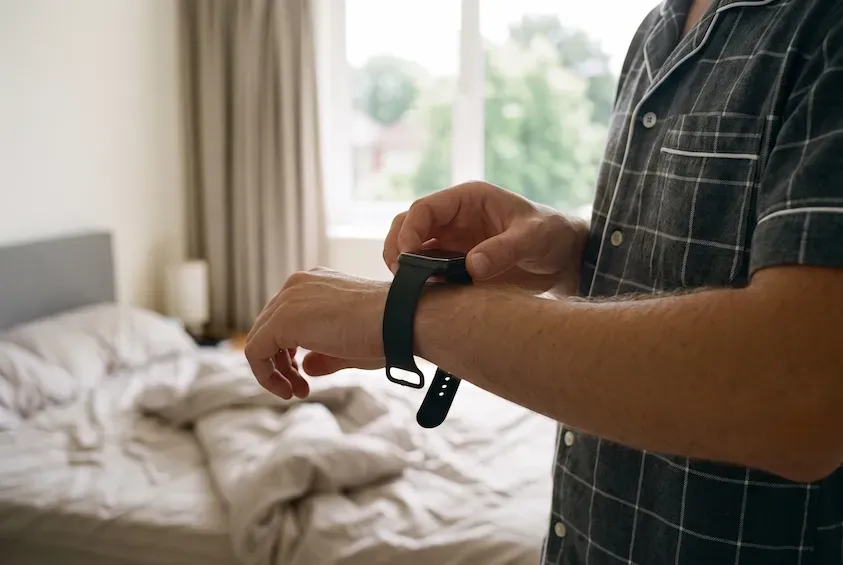
You woke up feeling fine. Then you checked your score, saw a 61, and now you feel worse.
That sequence should bother you more than the 61 does. Something has gone sideways when a device changes how you feel about a night you’d already assessed correctly on your own.
Sleep trackers aren’t useless. They’re just being asked to do something they can’t, while quietly doing something else quite well. Knowing which is which is the whole skill.
The Myth: Your Tracker Measures Your Sleep
It doesn’t measure your sleep. It measures a couple of things about your body and infers your sleep from them.
A wrist-worn device typically knows how much you’re moving and roughly what your heart is doing. From those, software estimates when you fell asleep, when you woke, and what stage you were in at any moment.
That’s inference, not measurement, and it’s worth holding onto because the confident interface hides it. A bar chart with clean colored bands looks like a readout from an instrument. It’s closer to a well-informed guess presented with more certainty than it has earned.
What They Get Reasonably Right
Being fair to them, because this part is genuinely useful.
Roughly when you fell asleep and woke up. Movement is a decent proxy for this, and the estimate is usually in the right neighborhood.
Total time asleep, approximately. Not exact, and it tends to be generous if you were lying very still while awake, but useful.
Trends over weeks. This is where they earn their place. Any individual night’s data is noisy, but a month of it can show you something real: that your sleep is shorter on weeknights, that your timing drifts at the weekend, that something changed when you started a new routine.
Consistency of your schedule. Genuinely valuable, since a steady wake time is one of the highest-value things to get right, and a tracker makes drift visible in a way that memory doesn’t.
Prompting you to notice. Sometimes the useful thing a tracker does is make you pay attention to sleep at all.
What They Get Wrong
Sleep stages, most of all. This is the least reliable thing on the screen and typically the most prominently displayed. Distinguishing deep sleep from REM from light sleep properly requires measuring brain activity. A device on your wrist isn’t doing that; it’s guessing from movement and heart rate, and the guess is rough. If you take one thing from this article, make it this: treat the stage breakdown as decorative.
The sleep score. A single number combining several estimates, weighted by choices the manufacturer made, presented as though it were a grade. Different devices score the same night differently, which tells you the score is a product decision rather than a fact.
Lying still but awake. If you’re motionless and calm while awake, you can be scored as asleep. Which means the nights you most want measured accurately, the ones where you lay there for an hour, are the ones it’s most likely to get wrong.
Anything about why. A tracker can suggest your sleep was disturbed. It cannot tell you whether that was the room temperature, your partner, a drink, or a deadline. The diagnosis is still yours to do.
The Problem With Grading Yourself Each Morning
There’s a real trap in daily scoring, and it’s becoming common enough to be worth naming.
Anxiety about sleep makes sleep worse. That isn’t a soft claim; the effort of trying to sleep, and the worry about whether you’re succeeding, are among the more effective ways to stay awake.
So a device that hands you a grade every morning, and invites you to feel judged by it, is introducing exactly the ingredient that causes the problem. People end up chasing a number, going to bed anxious about tomorrow’s score, and sleeping worse than they did before they started measuring.
The tell is straightforward: if your score regularly changes how you feel about a night, that’s a sign the tracker is costing you more than it’s giving.
Your own morning assessment, before you look, is better data than the score. You know whether you feel rested. That’s the actual outcome; everything on the screen is a proxy for it.
How to Use One Well
Look weekly, not daily. The trend is the signal. The nightly number is mostly noise, and checking it each morning is the behavior that causes the trouble.
Ignore the stage breakdown. You can’t act on it, you can’t control it, and it’s the least accurate part.
Use it for timing, not quality. When you went to bed, when you got up, how consistent that was. That’s the part it measures best and the part most worth changing.
Form your own verdict first. Decide how you slept before you look. If they disagree often, trust yourself.
Run experiments, not audits. Change one thing, watch the trend for two weeks. That’s a use of data. Reading a grade each morning is not.
Take a break if it’s making you anxious. Take the thing off for a fortnight and see whether you sleep better without being marked. Plenty of people do.
When the Data Isn’t the Point
If you feel persistently unrested despite a reasonable amount of sleep, that’s worth a conversation with a doctor, and it’s worth having it about how you feel rather than about your app.
Bring the symptoms: daytime sleepiness affecting your work or driving, loud habitual snoring, anyone noticing you gasping or seeming to stop breathing during sleep, waking with headaches. Those are useful clinically. A screenshot of a sleep score is not, and consumer devices aren’t diagnostic tools.
The Honest Verdict
A sleep tracker is a decent schedule log and a poor sleep laboratory.
Use it to see whether your timing is consistent and whether your total is drifting, which are the two things it does well and the two things most worth fixing. Ignore the stages, hold the score loosely, and never let it overrule how you actually feel.
The best-measured night is worth nothing if you spent it worrying about the measurement.


