You were outside all day. You walked miles, you ate by a fire, you were pleasantly wrecked by nine.
And you spent the night surfacing every ninety minutes, cold from below, listening to something rustling, doing that thing where you check whether it’s nearly morning yet and discover it’s twenty past one.
Camping sleep has a reputation for being bad, and it’s usually blamed on the ground being hard. That’s rarely the main problem. Here’s what’s actually going on and the order to fix it in.
First: You’re Losing Heat Downward, Not Sideways
This is the single most misunderstood thing about sleeping outdoors, and it’s why people buy warmer sleeping bags and stay cold.
Your sleeping bag works by trapping air in loft. Underneath you, your body weight crushes that loft flat, so the insulation there does almost nothing. Meanwhile the ground is a very large, very cold object in direct contact with you, drawing heat away all night.
So you can be inside a bag rated well below the actual temperature and still be cold, because the cold is coming from below and the bag isn’t the part that addresses it.
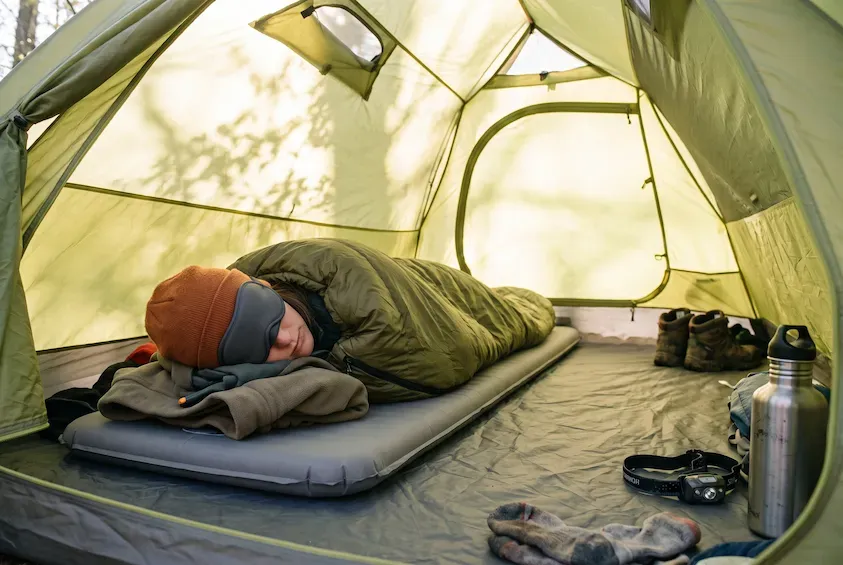
The fix is under you, not around you. A sleeping mat is not primarily for comfort; it’s insulation. If you’re cold at night, adding a mat, or a second layer under the one you have, will do more than any upgrade to the bag. A foam mat under an inflatable one is the classic cheap solution. In a pinch, spare clothing, a folded blanket, or dry leaves under the groundsheet all help.
Cold from below is the number one cause of bad camping nights, and it’s the one people fix last.
Second: The First Night Is Meant to Be Worse
If your first night out is rough and the second is fine, nothing is wrong with you.
In an unfamiliar place your brain keeps more capacity in reserve for monitoring what’s around you. It doesn’t yet know which sounds are normal here, so it treats more of them as worth checking. Outdoors this is amplified, because almost every sound is unfamiliar and some of them are genuinely animals.
Your sleep sits lighter, you surface more, and you remember less of it than actually happened. By the second or third night it settles considerably. This has its own mechanics worth reading about, and the practical upshot for camping is: plan the demanding day for later in the trip, and don’t judge the whole thing by night one.
Third: The Sun Is Now Your Alarm Clock
At home you control the light. In a tent you don’t.
Nylon is not opaque. It gets light inside long before sunrise, and it heats up fast once the sun is on it, which is why a summer tent goes from pleasant to unbearable within about twenty minutes. Meanwhile it gets dark early and there’s nothing to do, so you go to bed at nine and are wide awake at four.
Practical responses: pitch where you’ll get morning shade if you have the choice, which usually means thinking about where the sun comes up rather than where the view is. An eye mask solves the light entirely and packs down to nothing. And accept some shift in your timing, because going to bed early and waking early outdoors is largely the point.
Fourth: The Noise Is Unfamiliar Rather Than Loud
A campsite at night is usually quieter than your bedroom at home. It just doesn’t sound like anything you’ve learned to ignore.
Wind on fabric, a branch, something small moving through undergrowth, someone else’s tent zip at 2 a.m. None of it is loud. All of it is unclassified, and unclassified is what your brain flags.
Earplugs help a lot here, and they’re worth knowing about correctly: foam and wax reduce sound rather than eliminate it, so you’ll still hear anything that genuinely needs your attention. A steady sound source does the same job by reducing contrast if you’d rather not block your ears.
The Practical Order to Fix Things
1. Sort your insulation from the ground up. Mat first, then bag. If you’re cold, add underneath before you add on top.
2. Go to bed warm, not cold. Getting into a bag already chilled means spending hours heating it with a body that doesn’t have much spare. Move around, do some star jumps, have something hot, then get in. A bottle of hot water in the bag half an hour before is a real trick and it works.
3. Change your socks and base layer. Damp clothing from the day will keep you cold all night, and you probably won’t notice it’s damp. Dedicated dry sleeping clothes are worth the pack space.
4. Deal with the head and feet. A hat in cold conditions makes a disproportionate difference. Don’t sleep with your head inside the bag, though: breathing into it makes everything damp, and damp insulation stops insulating.
5. Empty your bladder before bed, however cold it is out there. Being warm and needing the toilet is a worse night than one brief cold trip.
6. Level the ground and clear it properly. Head slightly uphill if you have a slope. Ten minutes clearing stones beats eight hours on them.
7. Bring the light and noise fixes. Eye mask, earplugs. Both weigh nothing.
The Safety Part, Which Is Not Optional
Two things matter more than anything else on this page.
Never use a fuel-burning stove, heater, lantern, or barbecue inside a tent, awning, or any enclosed space, including to warm it up before bed. Anything burning fuel produces carbon monoxide, which you cannot see or smell, and which kills people in tents every year. A barbecue that looks like it has gone out is still producing it. Cook outside, in the open, and let anything you’ve used cool down outside too.
Never block your ventilation. The vents in a tent look like they’re letting cold in, and closing them up is an obvious-seeming way to be warmer. It isn’t worth it: it traps moisture, which makes everything damp and therefore colder, and it removes the airflow that matters if anything is ever burning nearby. Insulate underneath and add layers instead.
If you’re cold, the answer is always more insulation, never more combustion.
When to Take It Further
If you’re consistently sleeping badly outdoors even with the insulation sorted, that’s usually the unfamiliarity rather than anything else, and it improves with nights spent out.
If you’re sleeping badly everywhere, not just camping, that’s a different subject. And if you’re exhausted during the day despite enough time in bed, or someone has noticed you snoring loudly or seeming to stop breathing while asleep, that’s worth raising with a doctor rather than adjusting your kit.
The Checklist
- Insulation underneath before insulation on top.
- Get in warm, in dry sleeping-only clothes.
- Hat on, head out of the bag.
- Eye mask for the four a.m. light, earplugs for the unfamiliar noise.
- Level ground, stones cleared, head uphill.
- Nothing burning inside the tent, ever, and vents stay open.
Fix the ground first. Almost every miserable camping night is a cold-from-below problem wearing a different explanation.