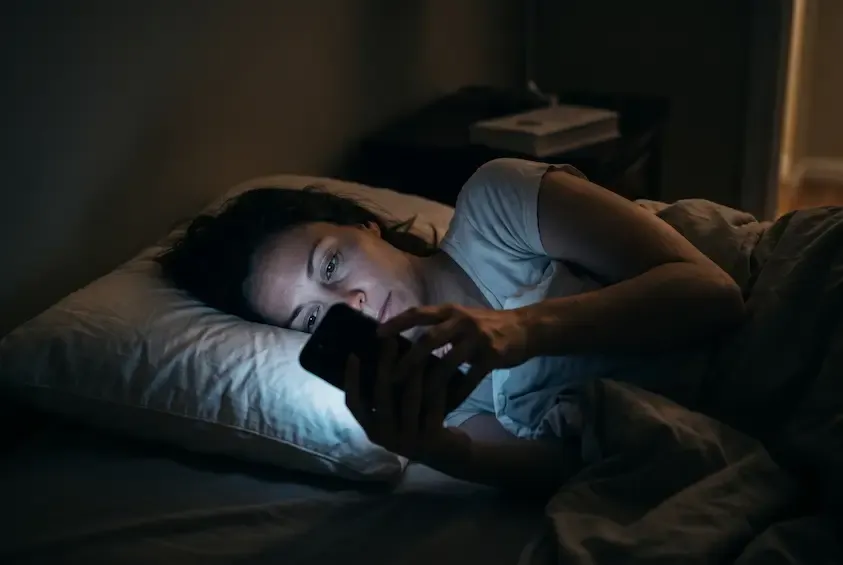
I did it for eleven years. Phone on the pillow, face lit up, one eye closed because the other one had gone blurry.
I want to be clear that I wasn’t doing anything interesting. I wasn’t reading long pieces or messaging people I love. I was looking at things I’d already seen, from people I don’t know, about subjects I don’t care about, at an hour when I was too tired to be selective and too awake to stop.
Then I’d put it down at some point I couldn’t have told you, and lie there wondering why I wasn’t asleep.
Here’s what I think was actually going on, and what changed when I stopped, including the parts that were disappointing.
The Argument That Never Worked on Me
Blue light. Every article led with it, and I had the night filter on, and it made no difference I could detect.
I’ve since come to think the light argument, while real, is the least important part of the case, and leading with it is why the advice bounces off people. My phone was not the brightest thing in my evening. The kitchen ceiling light was. Nobody ever told me to stop going into the kitchen.
If the light were the whole story, the filter would have fixed it. It didn’t, so it wasn’t.
What Was Actually Happening
Three things, none of which are about brightness.
I was arriving in bed activated rather than settled. Falling asleep isn’t a decision, it’s something that happens when nothing is preventing it. And a feed is a stream of small provocations: something mildly infuriating, something enviable, something requiring an opinion. Each is tiny. Cumulatively they kept me switched on, and switching on is easy while switching off takes time I wasn’t giving it.
I had no stopping point. This is the one I underrated most. Nothing about a feed ends. There’s no credits, no last page, no natural moment where the thing is over. So the decision to stop had to come entirely from me, at the hour when I was least capable of making it. I wasn’t choosing to scroll for forty minutes. I was failing to choose to stop, forty separate times.
I taught myself that bed is where you’re awake. This is the one that took longest to notice and did the most damage. For years, the thing I did in bed was be alert and engaged. Lying down stopped being a signal for sleep, because it had become a signal for the phone. By the end, getting into bed made me feel more awake, not less, and I’d assumed that was just how I was built.
The Part I Didn’t Expect
I thought I was losing sleep to the time. Forty minutes of scrolling meant forty minutes less sleep, and if I could just get that back I’d be fine.
That wasn’t it. When I stopped, I got the forty minutes back and it wasn’t the main improvement. The main improvement was that I fell asleep faster once I was in bed, which I hadn’t predicted at all, and which meant the real cost had been the state I was arriving in rather than the clock.
What Actually Worked, After Several Things Didn’t
Night mode. Did nothing.
Willpower. Did nothing. I would decide, sincerely, at nine o’clock, and be scrolling at eleven.
Time limits and app blockers. Worked for about a week each. I got very good at dismissing them.
Charging the phone in another room. This is the one that worked, and it worked immediately and completely.
It’s an unsatisfying answer because it isn’t clever. It’s just removing the option. Everything else I tried relied on me making a good decision while tired, and the whole problem was that I couldn’t. Putting the phone in the hall meant the decision was made at nine, by a version of me who was capable of making it.
The alarm objection is real and the fix is boring: get a cheap alarm clock, or leave the phone across the room. Having to stand up to turn it off turned out to be a benefit.
The Two Weeks You Should Know About
I’m not going to pretend it was pleasant.
For about a fortnight, lying in bed with nothing to do was genuinely uncomfortable. Not boring exactly. More like an itch. I’d been using the phone to skip the gap between lying down and falling asleep, and without it the gap was just there, with me in it.
What I hadn’t understood is that the gap is normal, and that filling it had been the problem. That discomfort passed. It took longer than I expected and less time than it felt like.
If you try this, expect a bad fortnight and don’t take it as evidence that it isn’t working.
What I Do Instead
Not much, and deliberately.
A physical book, which I read for about ten minutes before it falls on my face. The critical difference isn’t the paper, it’s that a book ends: a chapter finishes and there’s a natural moment where stopping is the obvious thing.
Sometimes nothing. Lying there. This is fine now, which is the change that surprised me most.
The Honest Caveats
Some people scroll for twenty minutes and sleep beautifully, and if that’s you, this isn’t a problem you have. I’m not making a moral case.
And this is one variable among several. My sleep didn’t become perfect. It became noticeably better on the specific dimension of how long it took to fall asleep, and that was worth the fortnight.
If you’re doing all this and still lying awake most nights over weeks, or if you’re exhausted during the day despite enough time in bed, that’s worth a conversation with a doctor rather than another habit change.
If You Take One Thing
The case against scrolling in bed isn’t really about light, and it isn’t mainly about lost time.
It’s that you’re arriving in bed switched on rather than winding down, and that you’re slowly teaching yourself that bed is a place where you’re awake. That second one is the expensive part, and it takes a while to undo.
Charge it in another room. Everything else I tried was a way of avoiding doing that.