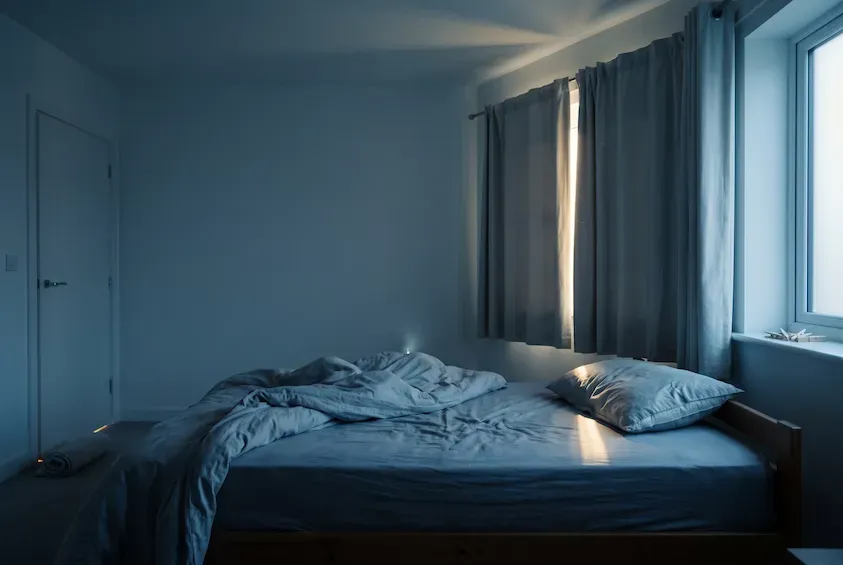
You are not a morning person, and yet you are awake at 5:20 in June, because the sun is up and your curtains are decorative.
The advice you’ll find for this tends to assume a budget and a drill. Here are seven things that work, ordered from free upward, with the most expensive coming in at less than a takeaway.
Do them in order. The first three cost nothing, and for a lot of rooms they’re most of the fix.
1. Roll a Towel Against the Door
Free, takes four seconds, and it’s the one people skip because it seems too obvious to matter.
If there’s a lit hallway on the other side, the gap under your door is a strip of light aimed across your floor at about the height of a bed. In a properly dark room it’s one of the brightest things there.
An old towel, rolled, does the whole job. A draught excluder does it more tidily if you already have one.
2. Turn the Standby Lights Around
Also free. Televisions, consoles, chargers, routers, air purifiers, plug sockets with a glow: a room can have half a dozen of these and you stopped seeing them years ago.
Three options per device, in order of preference: unplug it if it doesn’t need to be on overnight, turn it so the light faces a wall, or put something in front of it. A book works.
One exception, and it matters: never cover, tape over, or unplug a smoke alarm or a carbon monoxide detector. Their indicators are small and they are not why your room is bright. If one genuinely bothers you, that’s a conversation with your landlord or an electrician, not a job for tape.
3. Move the Bed, or Just Your Pillow
Free, and underrated.
Morning light comes in low and at an angle, which means it hits a specific part of the room rather than filling it evenly. If that part is your face, moving the bed a few feet, or swapping which end you sleep at, can take you out of the beam entirely.
Stand where your head goes, at the hour that’s waking you, and look at where the light is actually landing. Sometimes the fix is a foot to the left.
4. Clip the Curtain Gap Shut
A few clothes pegs, or bulldog clips if you want them to look deliberate. Pennies.
Curtains rarely fail through the fabric. They fail at the vertical gap in the middle where the two panels meet, and at the sides where they stop short of the wall. Clipping the middle overlap closed removes a bright vertical line that’s often pointed straight at the bed.
While you’re there: pull the panels wider than the window rather than neatly to its edges. Overlap beats tidiness.
5. An Eye Mask
The cheapest thing that reliably works, and the only one on this list that doesn’t care about your room, your landlord, or which direction your window faces.
Worth knowing if you’ve tried one and given up: the common failures are a strap that’s too tight to sleep in, and a flat shape that presses on your eyes so you can’t move them comfortably. A contoured one with room for your eyes to move solves both, and being able to open your eyes underneath it is the difference between wearing it all night and finding it on the floor at 2 a.m.
6. An Opaque Panel on a Tension Rod
The first item here that costs real money, and still not much.
A tension rod fits inside a window recess with no fixings, no screws, and no marks, which makes it the standard answer for a rental. Behind or in front of your existing curtain, hang something genuinely opaque: a blackout panel, a heavy blanket, even a cheap fitted sheet doubled over.
Go wider and longer than the window rather than matching it. What you’re aiming at is overlap on all four sides, because the leak is around the covering rather than through it.
If you’re renting and want the full version of this, including adhesive options and how to avoid taking the paint with them, that’s worth a separate read.
7. Close the Gap Above the Curtain
The last one, and the one that catches people who’ve already done everything else.
If your curtain hangs from a rod or a track, there’s an open channel above it where light pours straight in and washes across the ceiling. You won’t see it while you’re standing up. You’ll see it lying down, which is the position that counts.
A pelmet closes it: a panel across the top of the window, spanning wall to wall. Foam board or thick cardboard, cut to width and held with removable adhesive strips, weighs almost nothing and costs almost nothing.
Cheaper still: hang the whole covering higher, closer to the ceiling than the window, so the gap sits above where light gets in rather than below it.
Two Things Worth Knowing Before You Start
Audit in the dark, and wait. Turn everything off, get into bed, and give your eyes a full five minutes before you look around. Your judgment of how dark a room is gets made in the first few seconds, before your eyes have adjusted, and it’s the wrong judgment. Then repeat it at first light, because morning light finds gaps that midnight light doesn’t.
Don’t black it out and stop there. A very dark bedroom with a dim morning after it can make waking harder, not easier. Whatever you put up, open it as soon as you’re awake and get some real light early. The contrast between night and morning is the useful part, not the darkness on its own.
Keep the Window Usable
One safety note. If the window in question is one you’d climb out of in an emergency, keep whatever covers it something you can pull down fast, in the dark, in a hurry. That rules out adhering a panel permanently across it.
The Short Version
Towel at the door, standby lights turned away, bed out of the beam. Those three are free and they fix a surprising number of rooms.
If light is still waking you after that, an eye mask is the cheapest reliable answer, and a tension rod with something opaque on it is the cheapest permanent one. Do the free things first: you may find you need less than you thought.