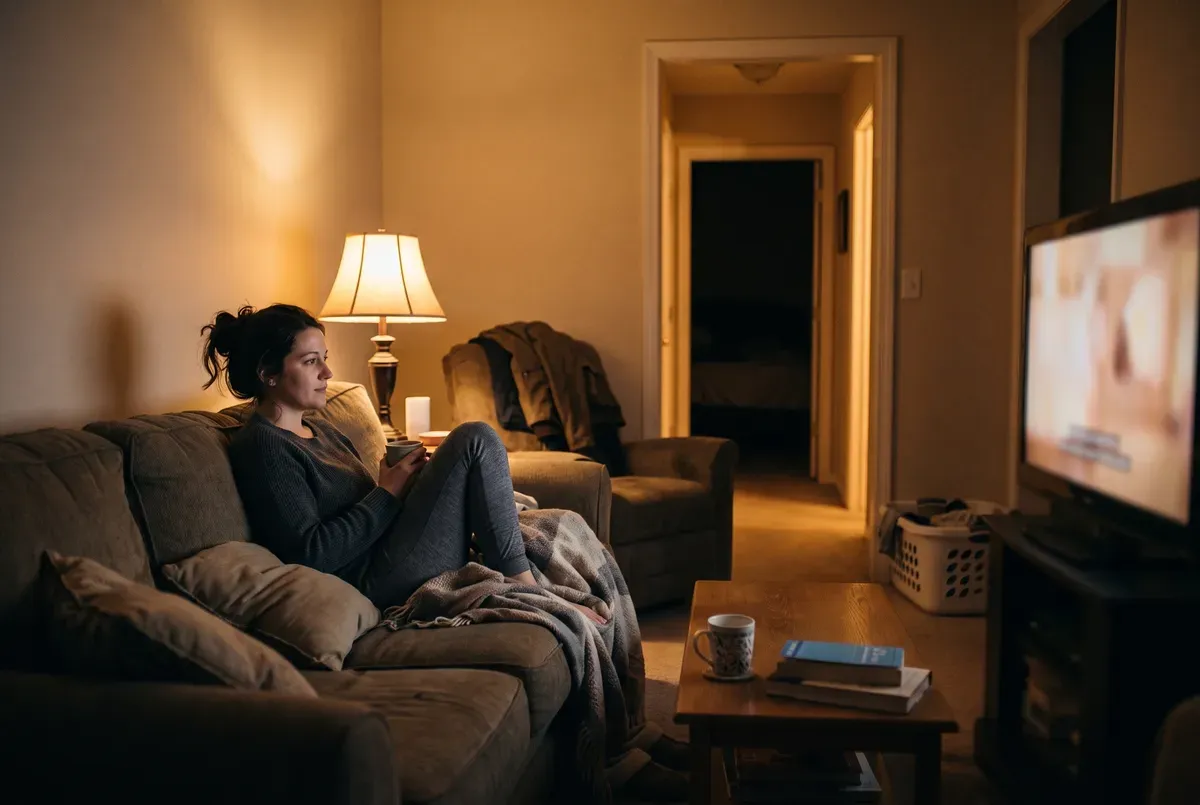
Someone has said it to you. Probably several someones, in a kind voice, as though handing over a key.
Sleep when the baby sleeps.
And you’ve stood in the kitchen at 11 a.m., baby finally down, holding the four things that need doing before the next feed, working out whether it’s even possible to be asleep in the eight minutes it would take to get there.
The advice isn’t wrong, exactly. It’s just missing every part that makes it hard.
Why the Advice Fails in Practice
Three things get skipped.
Falling asleep on command is a skill, and exhaustion doesn’t grant it. Being wrecked doesn’t mean you can drop off in five minutes in daylight with dishes visible from the sofa. Often the opposite: you’re wired, listening, half-expecting a noise.
The window is unpredictable and often short. A nap you can’t plan is a nap you can’t prepare for. By the time you’ve decided to take it, some of it is gone.
The other work doesn’t disappear. “Sleep when the baby sleeps” quietly assumes the alternative is leisure. It isn’t. It’s the only stretch of the day when you can do anything with two hands.
So the goal here isn’t to try harder at the same advice. It’s to lower the cost of taking the window when it appears.
Step 1: Decide in Advance, Not in the Moment
The decision is the expensive part, and you’re least equipped to make it exactly when it’s needed.
Pick one predictable-ish sleep of the day, usually the longest one, and pre-commit: that one is yours. Not every nap. One.
Everything else stays available for laundry, food, or sitting quietly staring at nothing, which is also a legitimate use.
Deciding once removes the daily negotiation with yourself, which is what usually ends with the window gone and the dishwasher half-loaded.
Step 2: Get the Set-Up Down to Under Two Minutes
Whatever you have to do before you can lie down is a tax on every attempt. Pay it in advance.
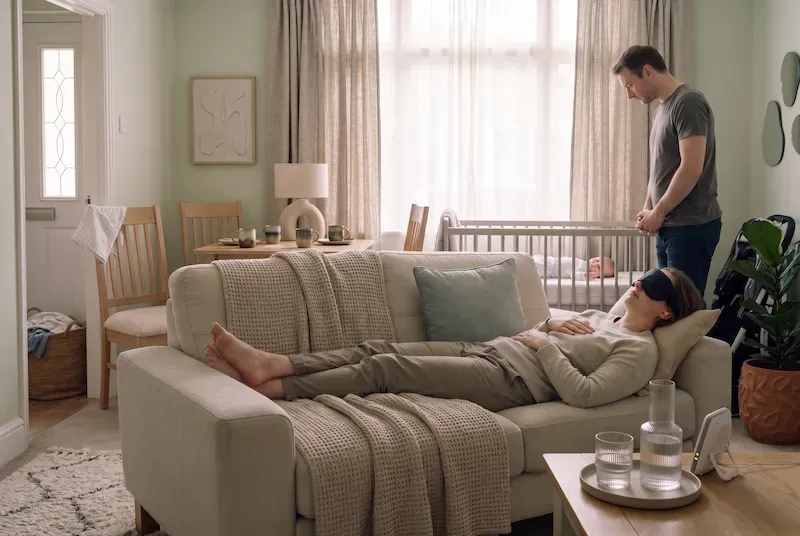
Leave the bed or the sofa ready. Blanket out, curtains already drawn, an eye mask and earplugs within reach if you use them. Have water there. Charge the monitor in the morning, not at the moment you want to sleep.
If earplugs make you anxious about not hearing the baby, it’s worth knowing that foam and wax reduce sound rather than eliminate it, so a nearby cry stays audible. If they still don’t feel right, don’t use them; the anxiety costs more than the quiet buys.
Step 3: Lie Down Even If You Won’t Sleep
This is the one that changes things.
Set the bar at horizontal, eyes closed, not at unconscious. If you sleep, good. If you don’t, you’ve still taken load off, and you haven’t failed at anything.
The reason this matters is practical rather than philosophical. When the target is “must fall asleep,” every minute awake is evidence you’re blowing your one chance, and that pressure is precisely what keeps you awake. When the target is “lie down,” there’s nothing to fail at, and you’ll often drop off as a side effect.
Slow your breathing out, longer on the exhale than the inhale. That’s a small physical lever and it doesn’t require you to stop thinking, which you can’t do to order anyway.
Step 4: Take the Length You’re Given
Ordinary nap advice says keep it short, around 20 minutes, so you surface easily. That’s still the best default, and if your window is short, use it.
But when you’re properly sleep-deprived, the usual rules bend. Sleep debt is real and a longer sleep may be more valuable than a tidy one, even at the cost of waking up groggy. If the baby is down for two hours and you can sleep for 90 minutes, take the 90 minutes and accept a foggy ten minutes at the other end.
The one length to avoid if you have the choice is the 30-to-60-minute middle, where you’re most likely to be pulled out of deep sleep. Shorter or longer both come out better. If the baby chooses that length for you, so be it; that’s not a decision you get to make.
Step 5: Hand the Window Over When You Can
If there’s another adult, the most valuable thing they can do isn’t the dishes. It’s taking the baby out of earshot for a defined block so you can sleep without listening.
Be specific: not “I’ll take the baby for a bit,” but “I have him from one until three, in the park.” Half-sleep while on standby isn’t the same as sleep, and vague cover leaves you on standby.
If there’s no one, “in earshot but not responsible” is worth asking a friend or family member for. It’s a smaller ask than people expect, and it’s more useful than a casserole.
Common Mistakes
- Waiting until you feel sleepy enough to deserve it. By then the window’s usually gone.
- Using the whole window for tasks, every time. The tasks expand to fit. One protected sleep isn’t negotiable against a tidy kitchen.
- Scrolling first, “just for five minutes.” It’s a reliable way to lose the window, and the light and input make dropping off harder.
- Treating a failed nap as proof it doesn’t work for you. Some attempts won’t produce sleep. That’s the ordinary distribution, not a verdict.
- Doing it all yourself because asking feels like admitting something. It isn’t.
When to Talk to Someone
Exhaustion with a new baby is expected, and it’s usually about the situation rather than anything being wrong with you. But there are things worth flagging rather than absorbing.
If you can’t sleep even when the baby is asleep and someone else is watching them, that’s worth mentioning to your doctor or health visitor: lying awake in a protected window is a different problem from not having one.
Please also raise it with a professional if you’re feeling persistently low, anxious, disconnected from the baby, or having thoughts that frighten you. Those are common, they’re taken seriously, and they’re treatable with the right support. Being exhausted and needing help are not the same thing, and you don’t have to work out which one you’re dealing with by yourself.
The Short Version
“Sleep when the baby sleeps” fails because it’s a slogan, not a plan.
Pick one sleep a day and call it yours. Make the set-up cost nearly nothing. Lie down whether or not you’ll sleep, because taking the pressure off is what lets it happen. Take the length you’re offered rather than the length the internet recommends. And when there’s another pair of hands, ask for a defined block rather than vague help.
None of this makes the first months restful. It makes the rest you can get slightly easier to reach, which on some days is the whole available win.