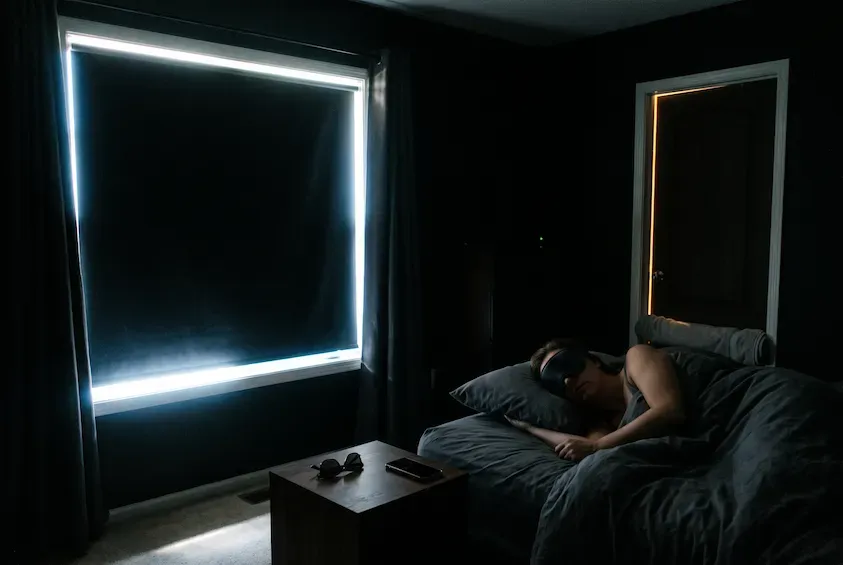
Most sleep advice is written for people who work days. Get morning light. Keep a consistent bedtime. Wind down in the evening. None of it survives contact with a rota that has you finishing at seven in the morning.
You’re being asked to sleep when your body is at its most alert, in a world that’s awake and bright, then to be sharp at four in the morning when it wants to shut down. That’s a hard problem without a complete solution. What it has is a set of adjustments that make a real difference, in the order that gets the most back.
Why Daytime Sleep Is Worse, Not Just Inconvenient
Your internal clock decides when you get sleepy and when you’re alert, and it’s set mainly by light. Daylight tells it, all day, that this is the alert part. So when you lie down at eight in the morning you are asking for sleep during the window your body is actively working to keep you awake in.
The result is sleep that’s shorter and lighter than the same hours at night. You’ll often drop off fast, because you’re exhausted, then surface after a few hours wide awake and unable to get back down. That isn’t you failing at it. That’s your clock arriving at its alert phase on schedule.
So the goal isn’t to sleep like a day worker. It’s to protect the sleep you can get and stop losing it to things you control.
The Commute Home Is the Dangerous Part
This first, because it’s the only item on this page that can kill you.
Driving after a night shift, especially the drive home at the end of one, is genuinely hazardous. You’re at the low point of your alertness, you’ve been awake a long time, and the drive is familiar enough to feel automatic. Falling asleep at the wheel does not come with a useful warning.
If you take one thing from this article, take this: plan the journey home as part of the shift, not as an afterthought. Public transport where possible, a lift share, or a short nap before you drive if the drive is long.
If you find yourself drifting, blinking hard, or not remembering the last stretch of road, stop properly. Worth raising with your employer too: some have policies precisely because it’s a known risk.
Step 1: Make the Bedroom Genuinely Dark
The highest-value fix, and mostly cheap.
Daytime light through a curtain is dramatically brighter than anything you’d face at night, and it’s arriving during the hours you need to be asleep. Full darkness matters more for a night worker than for anyone else.
Free things first: standby lights turned away or unplugged, a towel against the door gap, existing curtains pulled wider and longer than the window rather than neat to its edges, since the leak is around a covering rather than through it. Never cover or unplug a smoke alarm or carbon monoxide detector, whatever else you turn off.
Then the window itself, with something genuinely opaque that extends past the frame on all sides and closes the channel above the curtain. Then an eye mask for whatever’s left, which earns its place for a shift worker more than for anyone else, since you may be sleeping somewhere you can’t modify at all. Both have detailed versions, including no-drill options, worth a separate read.
Step 2: Wear Sunglasses on the Way Home
This one sounds fussy and it’s one of the most effective things on the list.
Light on your commute home is a signal to your clock that the day is beginning, arriving at precisely the moment you’re trying to convince your body that it’s bedtime. An hour of bright morning light on the way home can undo a lot of what the blackout curtains are doing.
Dark sunglasses for the journey, kept on until you’re indoors. It’s the cheapest circadian intervention a night worker has.
Step 3: Protect the Sleep Window Socially
The part most guides skip, and often the actual problem. Daytime sleep gets interrupted by things night sleep doesn’t: deliveries, doorbells, family, and people who assume that at two in the afternoon you’re available.
Tell people the hours, explicitly. Not “I sleep during the day” but “I’m asleep from eight until three, please don’t call.” Vague boundaries get tested.
A sign on the door, and turn the doorbell off if it has an off switch.
Phone on do not disturb, with an exception list for the two or three people who’d need to reach you in an emergency. That exception list is what makes switching the rest off possible.
Deal with household noise. Earplugs, or a steady low-level sound to flatten the contrast that daytime noise creates, since daytime is all sudden sound. Earplugs reduce sound rather than eliminate it, so an alarm still gets through.
Step 4: Pick One Sleep Pattern and Keep It
There are two that work, and the mistake is drifting between them.
One long block right after the shift. Home, brief wind-down, sleep through the morning into the afternoon. Simplest, and it suits anyone who can drop off while still tired from work.
Split it. A shorter sleep after getting home, up for the middle of the day, then a second sleep before the shift. This suits afternoon family commitments, and it means you start the shift having slept recently, which helps considerably at four in the morning.
Either works. A different pattern every day doesn’t, because your clock never gets a stable signal to settle on.
On your days off there’s a genuine trade. Flipping fully to days gives you your social life and costs a brutal re-adjustment; staying near your shift pattern keeps you functional and costs you the weekend. A late-night, late-morning compromise is the common middle path.
Step 5: Use Caffeine Deliberately, and Stop Early
Caffeine works well for night shifts, and the mistake is having it late. Early in the shift, yes. In the last few hours, no, because it’s still there when you’re trying to sleep at nine. Treat the end of your shift as your cutoff, the way a day worker treats the early afternoon.
A short nap before a shift is worth more than an extra coffee during it, and it costs you nothing at the other end.
When to Talk to Someone
Being honest is more useful than being encouraging here: night work is hard on sleep in ways that good habits reduce rather than remove. If you’re doing all of the above and still finding it difficult, that isn’t a failure of discipline.
Worth raising with a doctor, and worth doing sooner rather than later:
- Persistent insomnia during your sleep window despite a dark, quiet room
- Falling asleep unintentionally, especially while driving or operating anything
- Exhaustion that doesn’t lift on your days off
- Low mood, or a marked change in it, alongside the schedule
- Digestive problems that started with the shift pattern
There are recognized difficulties associated with shift work, they’re taken seriously, and there are approaches that help. Bring your rota to the appointment; the pattern is the useful information.
The Recap
- Plan the commute home before anything else. It’s the real risk.
- Black out the bedroom properly, free steps first.
- Sunglasses home, and keep them on until you’re indoors.
- Tell people the exact hours, and turn the doorbell off.
- Pick one pattern, single or split, and hold it.
- Caffeine early in the shift, none at the end.
Two and three are the pair that do the most: darkness where you sleep, and no light on the way to it.