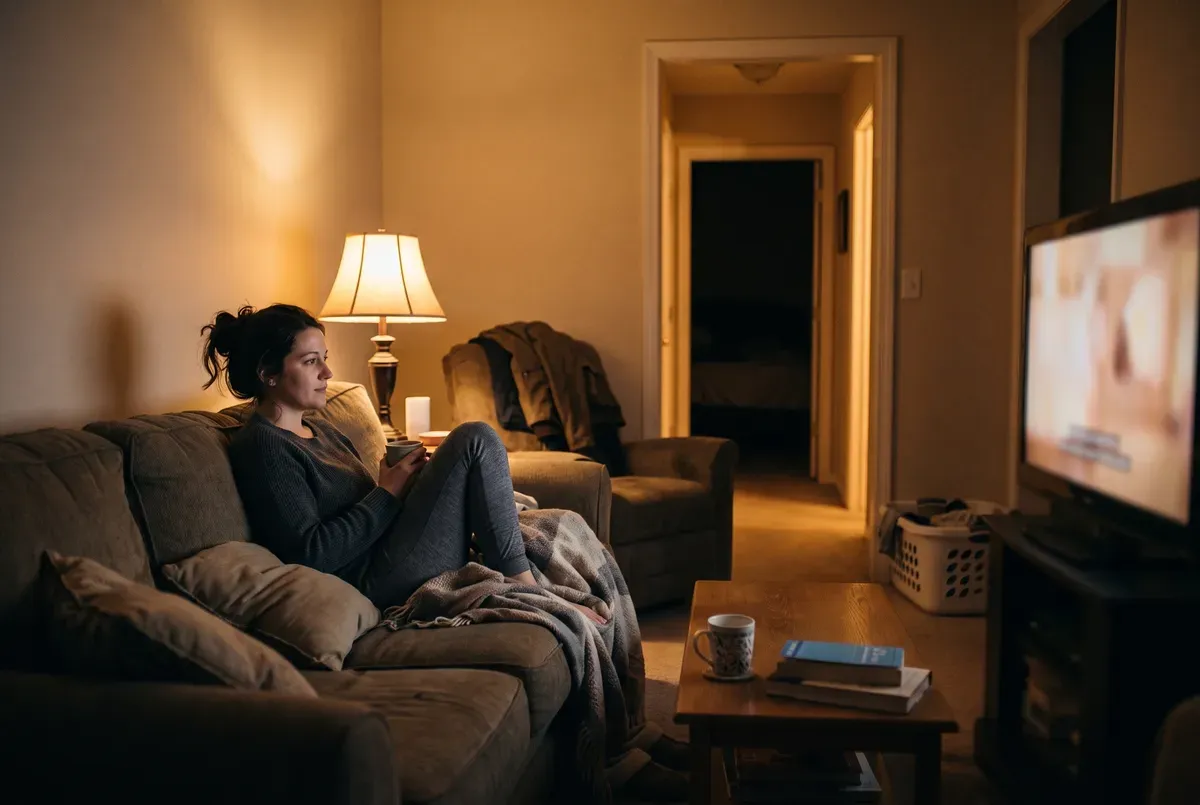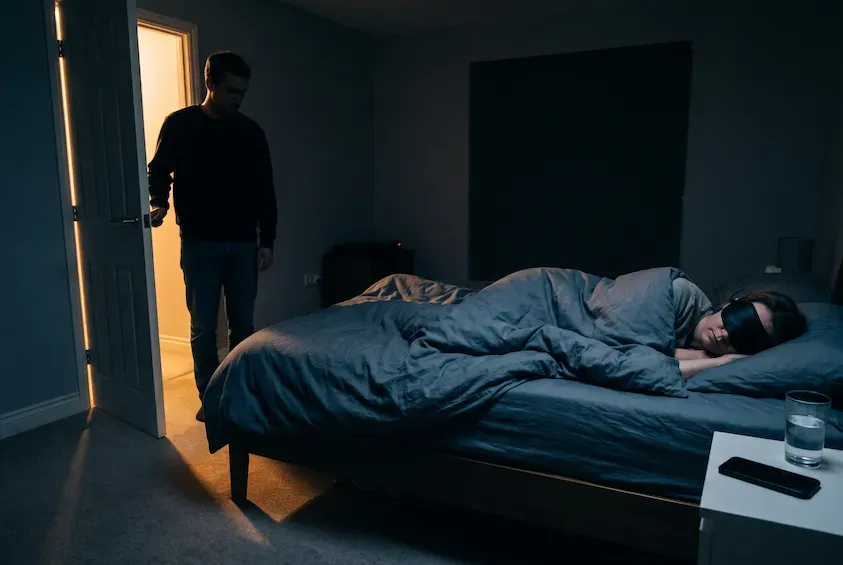
You go up at ten because you’re up at six. They come to bed at half past midnight, and there’s the landing light, and the wardrobe door, and the four minutes of settling, and then you’re awake.
Or the reverse: you’re the late one, creeping around in the dark trying to undress silently, aware that any noise makes you the villain, and then getting into bed rigid so as not to disturb them.
Neither of you is doing anything wrong. You’re just on different clocks, sharing one room, and nobody warns you that this becomes one of the more persistent frictions of living with someone.
Why This Is a Real Problem, Not a Fussy One
Two mechanisms, and it’s worth naming both because they’re often confused.
Disturbance costs sleep even when you don’t wake. A sound or a light can lift you briefly toward the surface without ever bringing you fully awake, and you won’t remember it in the morning. So “I didn’t wake you, did I?” and “no, I slept fine” can both be sincere and both be wrong. The night still got broken up.
Anticipation is worse than the disturbance. Once you’ve been woken a few times by someone coming to bed, you start listening for it. That state of waiting is fundamentally incompatible with falling asleep, and it often costs more than the actual noise does. The early sleeper ends up braced from eleven onward for something that happens at half twelve.
Meanwhile the late partner is carrying their own version, which is the pressure of being the disruptive one, and doing everything in the dark badly as a result.
The Bit Worth Accepting First
You probably can’t fix the schedules, and trying to is where couples waste the most effort.
If one of you is naturally a late type and the other is naturally early, that’s largely not a choice either of you made, and it doesn’t respond to being asked nicely. Someone forcing themselves to an unnatural bedtime just lies there awake, which helps nobody.
So the workable version isn’t “get on the same schedule.” It’s make the transitions cost less, which is a logistics problem and considerably more solvable.
What Actually Helps
Prepare the late arrival in advance. This is the highest-value change and the easiest to miss. Before the early partner goes up, the late one gets everything ready: clothes for the morning out, phone charging, tomorrow’s bag packed, and crucially, what they’ll change into left in the bathroom or another room. Then coming to bed is one quiet action rather than fifteen minutes of moving around a dark bedroom.
Get undressed somewhere else. Obvious once said, rarely done, and it removes most of the noise.
Sort the door and the landing light. A lit hallway turns an opening door into a floodlight aimed at the bed. Turn it off before you open the door, and let your eyes adjust rather than needing light to navigate. A rolled towel at the base of the door deals with the strip along the floor.
Give the room a floor of steady sound. A fan or similar low-level constant sound reduces the contrast that makes a sudden noise register. It won’t cover a wardrobe door, but it takes the edge off the smaller sounds, which are most of them.
An eye mask for the early sleeper. It solves the light problem completely and independently of anyone else’s behavior, which is its real advantage: nothing depends on your partner remembering.
Earplugs if noise is the main issue. Worth knowing they reduce sound rather than eliminate it, so an alarm or a child stays audible.
Two separate duvets. Unromantic, transformative. Most of the disturbance of someone getting into bed is the covers moving, and this removes it entirely along with every argument about who pulls.
Deal with the alarm asymmetry. The early riser’s alarm is the mirror image of the same problem. Phone under a pillow on vibrate, or a quiet alarm, or a wearable that buzzes. And no snoozing, which converts one disturbance into four.
The Conversation Part
The framing matters more than the content.
It lands better as a shared logistics problem than as a complaint about a person. “The landing light wakes me and I’ve been lying there braced for it” invites a fix. “You always wake me up” invites a defense.
It also helps to have it during the day. Nothing useful has ever been negotiated at half past midnight by someone who has been lying awake for an hour.
And it’s worth each of you saying what you’d actually prefer, because assumptions accumulate. The late partner may be tiptoeing about elaborately over something you sleep straight through, while the thing that genuinely wakes you is the bathroom fan neither of you has mentioned.
On Separate Rooms
This deserves saying plainly, because it carries a lot of unnecessary shame.
Plenty of couples who like each other very much sleep better apart, some nights or every night, and are warmer for it in the daytime because neither one is running on empty. It’s a scheduling decision, not a verdict on the relationship, and treating it as a failure is what stops people trying it.
A middle version works well for a lot of people: same bed most nights, separate on the nights when one of you has an early start or a late finish that matters. It doesn’t have to be all or nothing.
The part worth protecting deliberately, if you do this, is the time together that used to happen at bedtime by default. That’s a real loss and it’s the one people don’t plan for. Moved somewhere else in the day, it’s fine.
When It’s Worth a Doctor
If the disturbance is loud habitual snoring rather than schedule mismatch, or if you’ve noticed your partner gasping or seeming to stop breathing during sleep, that’s worth raising with a doctor, and it’s a different problem from this one.
And if one of you genuinely cannot sleep before the early hours no matter how consistent the schedule, that’s worth a conversation too, rather than something to keep negotiating around at home.
If You Take One Thing
Stop trying to align the schedules and start reducing the cost of the handover.
The single change with the best return is the late partner getting fully ready before the early one goes up, so that coming to bed is one quiet movement instead of a fifteen-minute performance in the dark.