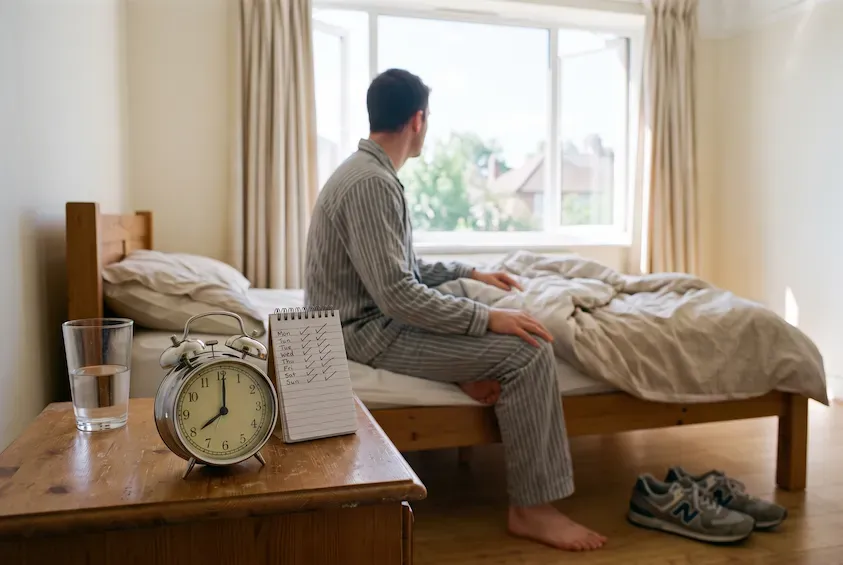
It didn’t happen in one night. It was a deadline, then a bad week, then a holiday, then a stretch where you were going to bed at two because you were already awake anyway, and at some point “temporarily off schedule” became just what your sleep is now.
Now you fall asleep at three, get up at ten on a good day, and feel vaguely unwell most of the time. And every attempt to fix it has looked the same: decide to go to bed at eleven, lie there until two, get up exhausted, give up by Wednesday.
Here’s why that approach keeps failing, and what to do instead.
Why “Just Go to Bed Earlier” Fails Every Time
Because bedtime isn’t the end you control.
Your body has an internal clock that decides when it will release you into sleep. It doesn’t take instructions and it isn’t influenced by your intentions. Getting into bed at eleven when your clock is set for two means lying there for three hours, which achieves nothing except teaching you that bed is a place where you lie awake, which is a second problem you didn’t have before.
The clock is set primarily by light and anchored by when you wake. So those are the two ends worth pushing on, and neither of them is bedtime.
The Reset, in Order
Do these in sequence. The order is doing a lot of the work.
Step 1: Pick a Wake Time and Refuse to Negotiate It
Not a bedtime. A wake time.
Choose the time you actually need to be up on a normal weekday, and commit to it every day, including weekends, for the length of the reset. This is the anchor, and if you only do one thing on this list, do this one.
It will be brutal for the first several days. That’s not a sign it’s failing; that’s the mechanism working. Getting up at the same time while still falling asleep late means you’ll be short on sleep, and that shortfall is what builds the pressure to fall asleep earlier. You’re using tiredness as the tool.
Step 2: Get Bright Light Within an Hour of Waking
The single most powerful input available, and it’s free.
Outdoors if at all possible, within the first hour, for ten or fifteen minutes. Daylight is dramatically stronger than indoor lighting even under heavy cloud, and the gap between “by a window” and “actually outside” is bigger than it looks.
This is what tells your clock where the day starts. Without it, the fixed wake time is doing half its job.
Step 3: Cut the Evening Light
The other half of the same lever, and the one that’s usually sabotaging you.
Bright light in the evening pushes your timing later, which is the direction you’re trying to move away from. Lower the lights in the last hour or two. Lamps rather than overheads. Dim everything, not just the screen, since a ceiling light is usually doing more than a phone.
Step 4: Move Bedtime in Small Steps, Later Than You Want
Here’s the counterintuitive part.
Don’t set the target bedtime yet. Go to bed when you’re actually sleepy, which at the start will still be late. Then let it come earlier on its own as the pressure from Step 1 builds.
If you want to steer it, move in steps of fifteen to thirty minutes and hold each step for several days before the next. Big jumps don’t hold, and a failed big jump usually ends the whole attempt.
Never lie in bed awake for long stretches waiting for sleep to arrive. If you’ve been there a while and you’re getting annoyed, get up, keep the lights low, do something dull, and come back when you’re drowsy.
Step 5: Eat and Move on the New Schedule
Meal timing and daytime activity are secondary cues for your clock, and they help.
Eat breakfast reasonably soon after your new wake time even if you’re not hungry, and get some movement during daylight hours. Neither is as powerful as light, and both make the light work better.
Step 6: Hold It at the Weekend
This is where most resets die.
Two nights of sleeping until midday undoes several days of progress, because your clock reads the weekend as a genuine schedule change. Within an hour of your weekday wake time is the compromise worth making, and during the reset specifically, tighter is better.
What to Expect, Honestly
Days one to four are the worst. You’ll be short on sleep and it will feel like the plan is failing. It isn’t; the shortfall is the engine.
Around the end of the first week, falling asleep starts getting easier. This is the first real signal.
Two to three weeks for the whole thing to feel settled, longer if you were badly shifted. If you were falling asleep at four and want eleven, that’s a big move and it needs time.
One bad night doesn’t undo it. Get up at the fixed time anyway. Sleeping in to compensate is what turns a bad night into a lost week.
The Two Mistakes That Ruin It
Going to bed early to catch up. More time in bed than you can sleep makes sleep lighter and more broken, and reinforces the association between bed and lying awake. It feels productive and it’s the opposite.
Sleeping in after a bad night. It moves the anchor, which was the only fixed point you had. Protect the wake time above everything, including on the mornings you least want to.
When to Get Some Help
If you’ve held a consistent wake time with morning light for a month and your timing hasn’t moved at all, that’s worth raising with a doctor rather than continuing alone.
Same if you genuinely cannot fall asleep until the early hours regardless of how consistent you are, and always have been. There are recognized patterns of shifted sleep timing that respond to specific structured approaches, and they work better with guidance. And your natural timing may simply be late, which is a different situation from a schedule that drifted, and is worth understanding before you fight it.
Also worth mentioning to a doctor: if low mood or anxiety came along with the schedule falling apart, or if daytime tiredness is affecting how you drive or work.
The Recap
- Fix the wake time. Every day, weekends included. This is the anchor.
- Bright light within an hour of waking, outdoors if you can.
- Dim the evening, all of it, not just screens.
- Go to bed when sleepy, and let it drift earlier as pressure builds.
- Eat and move on the new schedule.
- Hold the weekend within an hour.
The whole reset reduces to one idea: you can’t decide when to fall asleep, but you can decide when to get up and when to get light. Those two set the clock, and the bedtime follows on its own.