The room is fine. The bed is fine. The problem is the lift shaft on the other side of the wall, the group who came back at one, the door that slams every time anyone on the corridor uses it, and the fact that you have a thing to do tomorrow.
At home you’d fix the room. Here you can’t fix anything, you’re leaving in two days, and you have almost no control.
Almost. Here’s what you actually have, roughly in order of how much it gives you.
The Room You Get Is Mostly Decided Before You Arrive
The biggest lever is the earliest one, and it’s free.
Ask when you book, and ask again at check-in. A quiet room is a request most places will try to honor if you make it early and make it specific. “A quiet room” is vague. These are not:
- High floor. Away from street noise, loading bays, and bin collections.
- Away from the lift, the ice machine, and the stairwell. These run all night and they’re the most common source of corridor noise.
- Not facing the main road, and in a hostel or a busy area, not facing the courtyard or the smoking area either, which is often worse.
- Not next to the bar, the function room, or the kitchen.
- Not adjoining a connecting door to another room. Those doors transmit sound almost as if they weren’t there.
Ask to move if it’s bad. People are oddly reluctant to. Reception hears it constantly, it costs them little on a night that isn’t full, and the worst outcome is a polite no.
On Arrival, Spend Five Minutes on the Room
Before you unpack.
Find the noise sources you can switch off. Air conditioning that cycles loudly, a fridge that hums intermittently, a bathroom extractor on a timer. Intermittent is worse than constant, so anything that cycles is worth turning off entirely.
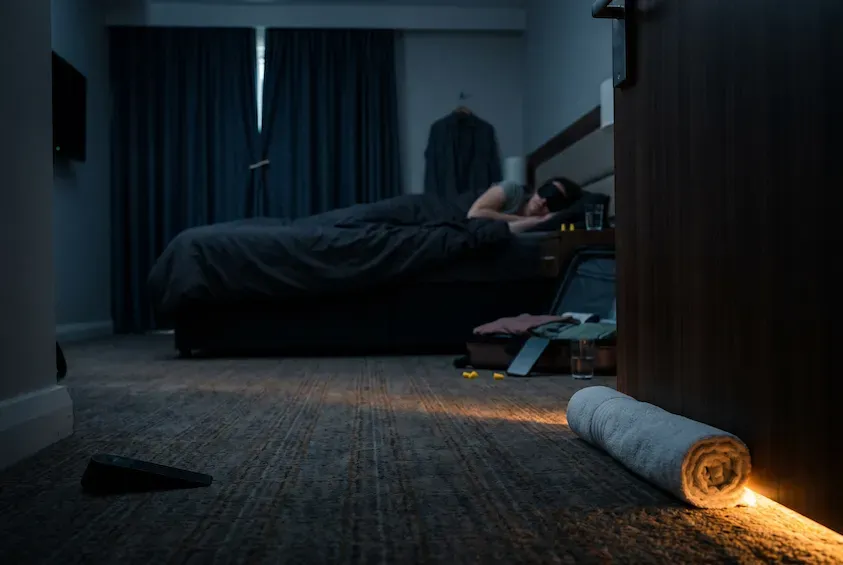
Check the door. A gap under it carries corridor sound and corridor light straight to you. A towel along the base handles both.
Look at where the bed is. If it’s against a wall shared with the corridor, the lift, or the next room, and the room layout gives you any choice, moving it, or sleeping the other way round, puts distance between your head and the wall.
Deal with the light while you’re there, because unfamiliar rooms are full of it: the standby lights on the television, the gap in the curtains, the corridor light under the door. It’s a five-minute job and you’re doing the door anyway.
Make the Room Less Reactive
Two things reduce how much any given noise costs you.
Soft surfaces absorb, hard ones bounce. Hotel rooms are often hard-surfaced. Hanging towels or clothes on the wall you share, and leaving a suitcase open on the floor, does more than it sounds like it should.
Give the room a floor of steady sound. This is the highest-value thing in the room, and it’s usually free. Sudden noise disturbs you because of the contrast against silence, not because of its volume. Adding a constant low-level sound shrinks that contrast, so the slammed door has less to stand out against.
The air conditioning fan set to run continuously is the classic version and it costs nothing. A bathroom extractor left on works. A phone playing something steady works. If you travel a lot, a small dedicated source is worth the space in a bag. Which type of sound you use matters much less than having one at all, and it needs to run all night rather than switching off after thirty minutes.
What to Carry
Free options first, and honestly the free options cover most rooms. But this is a case where you genuinely cannot modify the environment, so a small amount of kit does real work.
Earplugs. The single most useful thing to travel with for this. Foam or wax, whichever you’ll tolerate for a whole night. They reduce sound rather than eliminate it, which matters in a hotel: you will still hear a fire alarm, and you should not choose something that stops you hearing one.
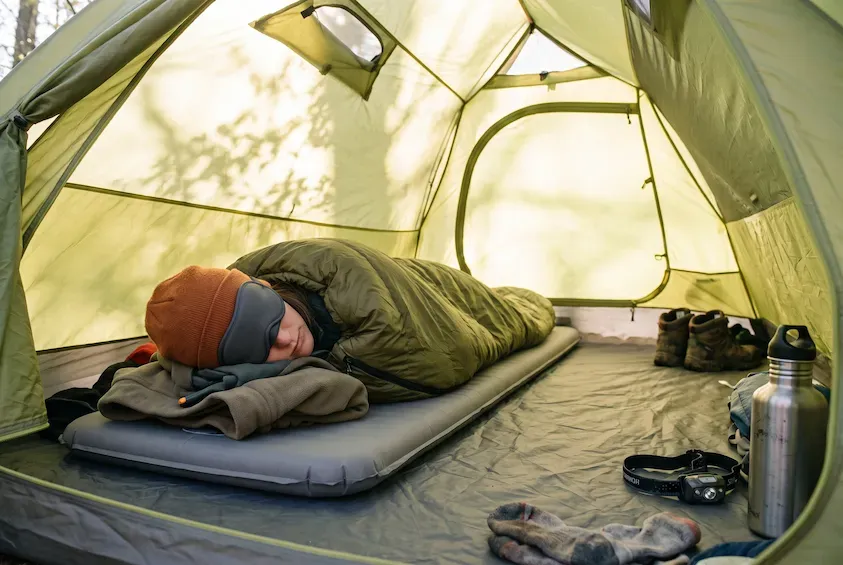
An eye mask. Unfamiliar rooms leak light from directions you don’t expect, and you can’t rewire someone else’s corridor. It also solves the curtain gap you can’t close.
A door wedge or a rubber stop, which is cheap, weighs nothing, and does double duty: it stops corridor light and it’s reassuring in a hostel or a ground-floor room.
The Hostel Version
Dormitories are a different problem, because the noise is people rather than machinery, and people are unpredictable.
Pick your bunk if you get a choice. Away from the door, away from the bathroom, away from the light switch. Bottom bunks are usually less disturbed by movement, though top bunks get less foot traffic past them.
Pack the night before. Rustling a bag at six in the morning is the standard hostel sin, and having your morning things out and ready means you don’t commit it, which also means you’re not lying awake dreading the person who will.
Accept the mismatch and use the tools. You can’t negotiate a dorm to quiet. Earplugs plus an eye mask plus a steady sound source is the whole strategy, and it works better than people expect.
Keep your exit clear. Whatever you do with a door wedge or your bags, don’t block your own way out.
The Airbnb Version
Different again, because you’re often in a residential building with no reception to complain to.
Read the reviews for noise specifically before booking. Search the listing’s reviews for “noise”, “loud”, “street”, “thin walls”. Recent reviews carry more weight than the average score.
Ask the host directly. “Which room is quietest?” and “is there anything that gets noisy at night?” A host who answers honestly is worth booking with.
You have more to work with once inside. Unlike a hotel, you can usually move furniture, close internal doors, and choose which room to sleep in. If the flat has two bedrooms and one faces the street, take the other one regardless of which one is nominally yours.
The Part That Isn’t the Noise
Worth knowing, because it explains why the first night is bad even in a quiet room.
Somewhere new, your brain hasn’t yet learned which sounds here are normal, so it treats more of them as worth checking and keeps more capacity back for monitoring. Sleep sits lighter and you surface more often.
That’s ordinary, it isn’t a sign that anything is wrong, and it improves considerably by the second or third night. The practical upshot for a short trip is to put the thing that matters most on day two rather than the morning after you arrive.
When It’s Worth Raising
If you sleep badly away from home on every night of every trip rather than just the first, if you’ve started avoiding travel because of it, or if the bad nights have begun happening in your own bed too, that’s worth mentioning to a doctor. A one-night adjustment and an ongoing pattern are different things.
The Checklist
- Request a specific quiet room when you book, and again at check-in.
- Ask to move if it’s bad. They hear it all the time.
- Turn off anything that cycles. Towel under the door.
- Move the bed away from the shared wall if you can.
- Hang soft things on hard walls.
- Run a steady sound all night, fan or otherwise.
- Earplugs and an eye mask, and don’t block your exit.
Numbers 1 and 6 are the two that do the most, and both are free.