Everyone else appears to be unconscious. You are upright, slightly cold, aware of your own neck, and doing the arithmetic on how many hours are left.
Sleeping on a plane is genuinely harder than sleeping anywhere else, and it’s worth saying that plainly, because a lot of advice implies you’re doing it wrong. You’re not. You’re trying to sleep sitting up, in noise, in dry air, in a seat designed around a different priority, while strangers walk past your head.
You can’t fix most of that. You can stack enough small advantages that sleep becomes possible rather than impossible. Here’s the order that gets the most out of the least effort.
Before You Book
Pick the window seat. This is the highest-value decision on the whole list and it happens weeks early. A window gives you something to lean against, which upright sleeping absolutely requires, and it takes you out of the aisle where the trolley, the queue for the toilet, and everyone’s elbows are. It also means nobody climbs over you at 3 a.m.
Avoid the back row and the row in front of an exit. Seats there often recline less or not at all, and reclining is a real part of this.
Think about which flight, not just which seat. A flight that lands in the early morning at your destination gives you a reason to sleep. One that lands mid-afternoon usually doesn’t, and forcing sleep at the wrong hour tends to cost more than it gives. Which direction you’re flying changes this considerably, and it’s worth a separate read on jet lag before a long trip.
Before You Board
Decide whether you’re actually sleeping. Look at what time it will be at your destination during the flight. If it’s night there, commit to sleeping. If it’s the middle of the day there, don’t fight for sleep you’ll pay for later. Deciding in advance stops you spending eight hours half-trying.
Eat before you fly if you can. Meal service is timed for the airline, not for you, and being woken for a tray at the one moment you’d drifted off is a real loss. Eating beforehand lets you decline it and sleep through.
Skip the airport drink. Alcohol makes it easier to fall asleep and reliably makes the rest of the night shallower and more broken, which is the opposite of what a limited window needs. In dry cabin air it also dehydrates you faster than it would on the ground.
Set yourself up so you never have to get up. Water in the seat pocket, everything you’ll want within reach, one trip to the toilet immediately before boarding closes.
The Kit, Cheapest First
Most of the advantage here is free. Some of it isn’t, and this is the one context where a couple of small purchases genuinely change the outcome, because you cannot modify the environment at all.
Free: layers. Cabins run cold, and being cold is one of the most common reasons people don’t sleep on planes. A hoodie doubles as a blanket, a pillow, and a hood over your eyes.
Free: the seatbelt over the blanket. Fasten it visibly on the outside so cabin crew don’t need to wake you to check it during turbulence. This single trick saves more interruptions than anything else on the list.
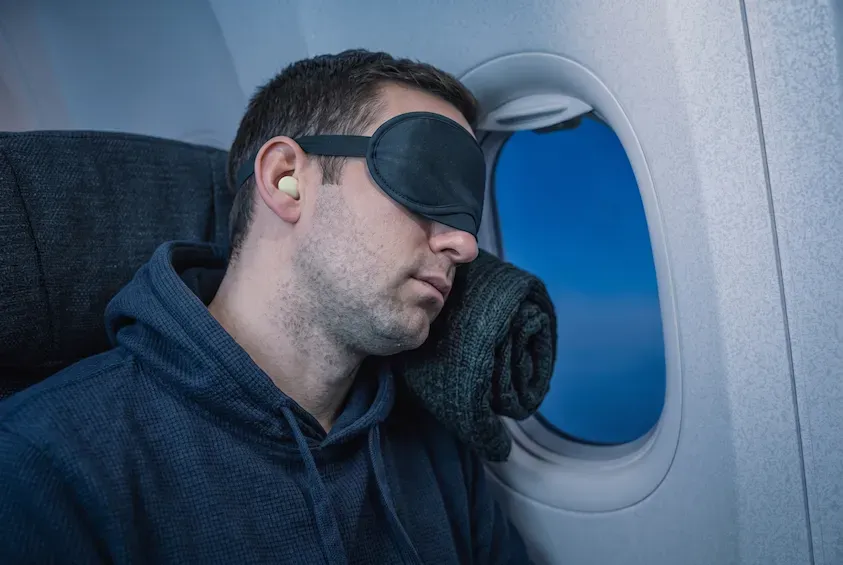
An eye mask. Cabin lights come up for service, the window across the aisle is a rectangle of daylight at 38,000 feet, and screens flicker in every direction. A mask handles all of it at once. Look for one that doesn’t press on your eyes, because a flat one you keep adjusting is one you’ll take off.
Earplugs, or something over your ears. Cabin noise is loud and constant. Steady sound is easier to sleep through than sudden sound, so the bigger win is usually covering the announcements, the crying, and the trolley rather than the engines. Worth knowing that earplugs reduce sound rather than eliminate it, so you’ll still hear anything that needs your attention.
Neck support that stops your head falling forward. This is the real problem with sleeping upright: your neck lets go, your head drops, and you wake. What matters is that it’s firm enough to actually hold, rather than soft and pleasant. A rolled jumper wedged between your head and the window works and costs nothing. If you buy something, the ones that support the front and sides rather than just the back are the ones that address the actual failure.
In the Air
Recline as soon as you’re allowed, and don’t feel bad about it. Even a small angle changes how much work your neck is doing.
Brace yourself against the window. Lean, wedge something between your shoulder and the wall, and give your body one stable position it doesn’t have to hold actively.
Do the wind-down anyway. The same short sequence you’d do at home: dim what you can, put the screen away, stop the caffeine. A routine your body recognizes works at altitude too, and it’s the one familiar signal available.
Lower the bar. You’re unlikely to sleep the way you do in a bed. Lying still with your eyes closed, not asleep, is genuinely restorative and it’s what most of the flight will realistically be. Treating it as failure adds pressure, and pressure is what keeps you awake.
Move every couple of hours when you’re awake anyway. Sitting still for a long stretch isn’t good for you, and a walk to the back and some ankle circles cost you nothing if you’re already up.
What Not to Do
- Drinking to get to sleep. Covered above, and it’s the most common mistake on any flight.
- Coffee at the airport “because it’s morning somewhere.” It’s a long flight and caffeine has a long tail.
- Sleeping whenever you feel tired. Tiredness in the air isn’t a signal about anything. Destination time is.
- Bracing for the whole flight. Holding yourself upright by muscle means you never let go enough to drop off. Find something to lean on.
On Sleeping Pills
Worth being direct, because it comes up constantly on long-haul.
Anything sedating, prescription or over the counter, is a conversation to have with a doctor or pharmacist before a flight rather than a decision to make at the gate. Two specific things they’ll tell you: never combine it with alcohol, and being deeply sedated in a seat is not the same as sleeping in a bed, including for how easily you can be roused if something needs your attention.
If you’re going to try something for the first time, the flight is the wrong place to find out how it affects you.
The Playbook
- Book the window, away from the back row.
- Decide before boarding whether this flight is a sleeping flight.
- Eat first, skip the drink, one last trip to the toilet.
- Layers on, seatbelt visible over the blanket.
- Mask on, ears covered, neck actually supported.
- Recline, lean into the window, run your usual wind-down.
- Aim for rest rather than sleep, and take the sleep if it comes.
The first two are free and made before you get on the plane, and between them they decide more than everything else combined.