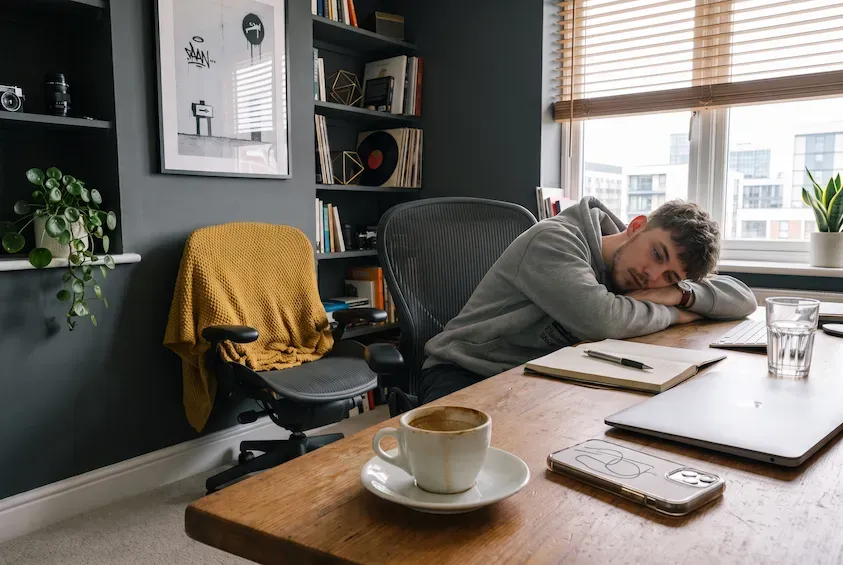
You have a four o’clock coffee and you sleep fine. Or you think you do.
That second part is the whole issue, because caffeine’s effect on your night is largely invisible from the inside. It’s not usually the dramatic version where you lie awake buzzing. It’s the quiet version, where you fall asleep at the normal time, sleep the normal number of hours, and wake up feeling like you didn’t.
Here’s how it works and where the sensible cutoff sits.
Caffeine Doesn’t Add Energy. It Hides Tiredness.
This is the mechanism, and everything practical follows from it.
While you’re awake, a substance called adenosine builds up in your brain. Rising adenosine is part of what makes you feel progressively more like sleeping as the day goes on: it’s the reason 3 p.m. is heavier than 9 a.m.
Caffeine doesn’t remove any of it. It occupies the places adenosine would otherwise attach to, so the sleepiness signal doesn’t get through as clearly. The tiredness is still there and still accumulating. You just can’t hear it.
Which explains the crash. When the caffeine clears, everything that built up in the meantime arrives at once, and it feels like a sudden drop rather than the gradual slope it actually was.
Why an Afternoon Coffee Is Still There at Bedtime
Caffeine leaves your system slowly. Not in an hour, and not by the time you’ve stopped feeling alert.
The important part: feeling the effect and having it in your system are different things. The alertness fades well before the caffeine does. So the fact that a 4 p.m. coffee doesn’t leave you wired at eleven doesn’t mean it’s gone. A meaningful amount can still be circulating at bedtime, dampening the sleepiness signal you need in order to fall asleep easily and stay down.
That’s the invisible cost. Not being unable to sleep, but sleeping more lightly and waking less restored, with nothing to connect it to.
The Curfew Worth Starting With
The mainstream guidance, and a reasonable default: stop caffeine by early to mid-afternoon. For most conventional schedules that means around two o’clock.
Treat that as the first setting to test rather than a rule handed down. A more useful way to hold it, since bedtimes vary: give yourself a good chunk of the afternoon and all of the evening caffeine-free, counting backward from when you actually go to bed rather than from a clock time. Someone who sleeps at nine and someone who sleeps at one should not have the same curfew.
Two adjustments worth making to that starting point:
Earlier if you’re sensitive. People vary a lot in how quickly they clear caffeine and how strongly they respond to it, and the variation is largely not something you chose. If you know you’re sensitive, midday is a better anchor than mid-afternoon.
Earlier if your sleep is already fragile. If you’re having a difficult stretch, caffeine is one of the few genuinely controllable inputs, and it’s worth being stricter than usual while you sort the rest out.
Where It Hides
The curfew fails most often because caffeine turns up where you weren’t counting it.
Tea, including green tea, has a real amount. Two afternoon cups is not a caffeine-free afternoon.
Decaf is not caffeine-free. It’s substantially reduced, not eliminated, which matters if you’re drinking several.
Chocolate, particularly dark, contributes a small amount. Rarely decisive, occasionally relevant late at night.
Energy drinks and pre-workout, which are usually the largest doses anyone takes, and often taken in the late afternoon.
Some painkillers and cold remedies include caffeine, sometimes without it being obvious on the front of the box. Worth checking if you take them regularly in the evening.
How to Test Your Own Cutoff
Don’t quit. Move it.
Pick a cutoff and hold it for a week. Two o’clock is a reasonable start. A week, not a night, because one night tells you nothing and you’ll draw a conclusion from it anyway.
Keep everything else the same, especially your wake time. If you change three things you’ll learn nothing about any of them.
Judge it on the mornings, not on how you felt in bed. The question is whether you’re waking more restored. That’s the outcome; how quickly you fell asleep is a secondary signal.
If nothing changes, move it earlier by two hours and repeat. If nothing changes again, caffeine probably wasn’t your problem, which is genuinely useful to know.
Expect two or three rough days if you’re cutting back overall rather than just shifting. Headache and flatness are ordinary and they pass. Reduce gradually rather than stopping dead if that’s easier.
The Loop Worth Noticing
Late caffeine makes the night shallower. A shallow night makes tomorrow harder. A hard tomorrow makes an afternoon coffee more appealing. And round it goes.
The loop is easier to break at the caffeine end than at the tiredness end, because that’s the part you decide. It usually takes about a week for the improvement to be visible, which is longer than you’ll want to give it.
Worth Checking With Someone
If you’re pregnant or breastfeeding, take regular medication, or have a heart condition, anxiety, or reflux, your sensible caffeine intake is a question for a pharmacist or doctor rather than an article. Pharmacists are good at exactly this and you don’t usually need an appointment.
And if you’re relying on caffeine to function despite spending enough time in bed, the caffeine is a symptom rather than the problem. Persistent daytime exhaustion is worth raising with a doctor.
The Short Version
Caffeine doesn’t give you energy, it masks the tiredness you’ve already accumulated, and it stays in your system long after you stop feeling it.
Start with a cutoff in the early afternoon, count backward from your actual bedtime rather than a clock time, and remember the tea. Hold it for a week and judge it on how you wake up, not on how fast you fall asleep.