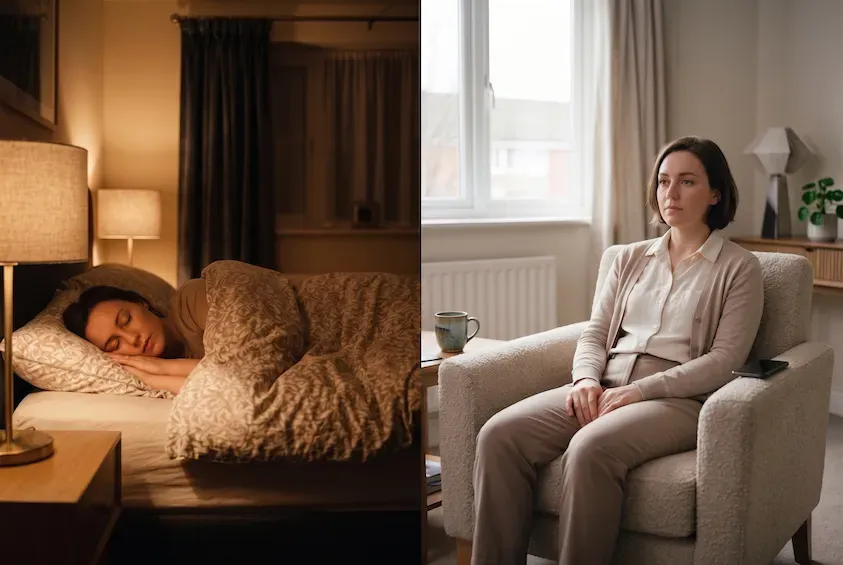
Drink a coffee, immediately lie down for 20 minutes, and wake up sharper than either the coffee or the nap would have made you on its own.
It sounds like it shouldn’t work. Caffeine is the thing that stops you sleeping. Drinking it on purpose right before a nap has the flavor of a hack invented to be posted rather than to be used.
But there’s a real mechanism here, and it’s genuinely interesting. It’s also narrower than the internet version suggests.
The Myth, and Where It Overreaches
The claim as it usually travels: the coffee nap is strictly better than a nap, strictly better than a coffee, and the closest thing to a cheat code for the afternoon.
That’s oversold. What’s true is more specific: the timing of caffeine’s onset happens to line up with the length of a short nap, and there’s a plausible reason the two might add up rather than cancel out.
Why It Isn’t as Contradictory as It Sounds
Two things are going on, and they don’t collide the way you’d expect.
Caffeine takes a while to arrive. Drink a coffee and you don’t feel it immediately. It has to be absorbed and reach your brain, which takes something in the range of 20 to 30 minutes. That delay is the whole basis of the trick: there’s a window after drinking it where you can still fall asleep, because the caffeine hasn’t landed yet.
Caffeine works by blocking a signal, not by adding energy. As you’re awake through the day, a substance called adenosine builds up in your brain. Rising adenosine is part of what makes you feel progressively more like sleeping, which is why you’re heavier at 3 p.m. than at 9 a.m. Caffeine doesn’t remove adenosine. It sits in the places adenosine would otherwise attach to, so the sleepiness signal doesn’t get through as clearly.
Here’s the part that makes the combination make sense: sleeping is what actually clears some of that built-up adenosine. So a short nap reduces the signal, and the caffeine arriving just afterward blocks what’s left. The nap does one job, the caffeine does the other, and they’re aimed at the same target from different directions.
That’s the mechanism. It’s reasonable, and it’s the honest level to describe it at.
What It Doesn’t Do
It isn’t extra sleep. You still napped for 20 minutes. If you’re short on sleep, you’re still short on sleep, and the coffee is masking rather than repaying it.
It won’t rescue a bad night. This is an afternoon-dip tool, not a recovery strategy. Used to paper over a chronic shortfall, it becomes a way of not noticing the shortfall.
It isn’t dramatically better than its parts for everyone. People vary a lot in how they respond to caffeine, and “I felt great” and “I felt nothing different” are both common outcomes. Treat it as worth one honest try rather than as a settled upgrade.
If You Want to Try It
Drink it quickly. Sipping a large coffee over fifteen minutes defeats the timing entirely. A small, quick one is the format. Something you can finish in a few minutes.
Lie down straight away. The window is short. Faff about for ten minutes and you’ve spent it.
Set the alarm for about 20 minutes. Same as a normal short nap: long enough to be useful, short enough that you surface out of light sleep rather than being hauled out of deep sleep.
Don’t worry about whether you actually slept. Drifting without properly falling asleep still takes some load off, and lying there anxiously auditing your own consciousness is the fastest way to guarantee you won’t drop off.
Do it early in the afternoon. Both halves argue for this. Caffeine has a long tail in your system, so a late coffee nap is a bill that arrives at bedtime.
Who Should Skip It
If caffeine makes you jittery or anxious, this will not be the exception. If you’re sensitive to it, or you already sleep badly, adding caffeine to the middle of your day is working against the thing you’re trying to fix.
If you’re pregnant, breastfeeding, taking regular medication, or managing a health condition, caffeine intake is worth a word with a pharmacist or doctor rather than a decision made from an article. Pharmacists are good at exactly this kind of question.
And if you’re needing something like this every day just to stay functional, the coffee nap isn’t the thing to optimize. Persistent daytime exhaustion despite enough time in bed is worth raising with a doctor.
The Honest Answer
Yes, there’s a real mechanism, and it’s a nicer piece of reasoning than most internet hacks have going for them. Caffeine’s delayed onset genuinely does leave room for a short nap, and the two do act on the same problem by different routes.
Whether you’ll feel it is a different question, and the only way to know is to try it once, early in the afternoon, and pay attention.
What it isn’t is a way around being tired. If the afternoon dip is the problem, this is a reasonable tool. If the night is the problem, the fix is in the night.