You slept eight hours. You have no complaints about the night. And by three in the afternoon you feel scraped out, in a way that more sleep doesn’t seem to address, because you already got the sleep.
The usual conclusion is that you need more of it. Earlier night, longer weekend, something.
Sometimes that’s right. Often it isn’t, because the thing you’re short of isn’t sleep. We treat the two words as interchangeable, and they aren’t: sleep is one specific thing your body does at night, and rest is a much broader category that sleep doesn’t cover.
The Substitution That Doesn’t Work
The assumption running underneath a lot of tiredness is that sleep is the master recovery process, and everything else is optional.
It’s easy to see why. Sleep is non-negotiable, it’s the one your body will force on you eventually, and it does an enormous amount. So it feels like the account everything is drawn from.
But some kinds of depletion don’t respond to being unconscious. You can sleep well every night for a week and still arrive at Friday with nothing left, because what emptied you wasn’t the kind of thing a night repairs.
Sleeping more doesn’t clear it. That’s the observation worth taking seriously rather than arguing with.
What Sleep Does, and What It Doesn’t Reach
Sleep handles the things that need you offline. Physical repair and maintenance. Filing what you learned. Processing emotional material. Resetting the systems that can’t be worked on while you’re using them.
It’s not a light version of resting. It’s a distinct biological process with jobs only it can do, which is why nothing substitutes for it.
But notice what it requires: you have to be unconscious for it. Which means it can only address what can be addressed while you’re not there.
The kind of depletion that comes from sustained attention, from decisions, from being responsive to other people all day, from never being unobserved, from having no gap between demands, is a different sort of tired. It builds during waking hours and it needs waking recovery. Being unconscious for eight hours doesn’t do it, because it isn’t a repair job. It’s a load that needs periods of not carrying it.
How to Tell Which One You’re Short Of
They feel different once you look for it.
Short on sleep usually feels physical. Heavy eyes, wanting to lie down, nodding off if you sit still, foggy first thing, a strong pull toward actually sleeping. It’s worse in the morning and after lunch, and it improves noticeably after a good night.
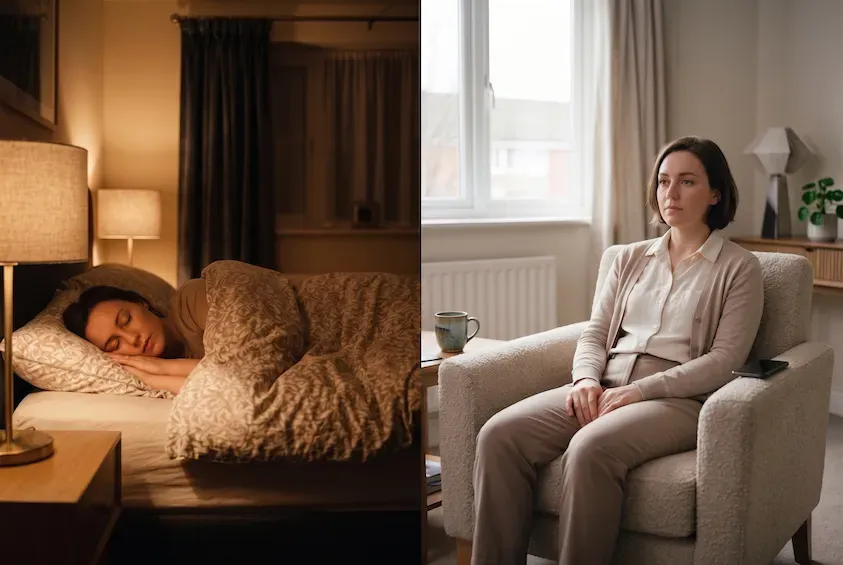
Short on rest feels more like depletion than sleepiness. You’re tired but not sleepy. You could lie down and wouldn’t sleep. Small decisions feel disproportionately hard. You’re irritable, flat, with no appetite for anything that requires initiative. And crucially, a good night’s sleep doesn’t fix it: you wake up and it’s still there.
That last one is the clearest test. If a genuinely good night doesn’t touch it, more sleep isn’t the answer you’re looking for.
You can be short of both at once, and often are, which muddies it. But the components respond to different things, so it’s worth separating them.
Why the Rest Half Gets Skipped
Three reasons, and they’re all recognizable.
Sleep has a slot and rest doesn’t. Sleep is scheduled, protected, and socially legitimate. Waking rest has no fixed time, so it gets whatever falls through the cracks, which is usually nothing.
Rest doesn’t look like anything. Sleeping is understood. Sitting doing nothing on a Tuesday afternoon looks like avoidance, including to yourself. So it gets postponed until it can be justified, which is to say until you’ve collapsed.
Half-rest doesn’t count and feels like it should. Scrolling with a coffee between two meetings is not a gap in the demands on your attention; it’s more demand in a different form. It passes time without restoring much, which is why you can take several of those a day and end up no better off.
What Waking Rest Actually Requires
Not much, and less than you’d think, but it has to be real.
A genuine gap in demand. Nothing to respond to, decide, or perform. That’s the active ingredient, and it’s the one most commonly missing.
Deliberate rather than accidental. Rest you fell into because you ran out of steam arrives too late to prevent anything. Rest you scheduled works considerably better.
Not necessarily doing nothing. Depending on what drained you, the restorative thing may be moving, making something, or being somewhere different rather than lying still. Which kind to pick when is worth its own read; the short version is that the right rest is usually the opposite of what emptied you.
Short is fine. Ten minutes of an actual gap beats an hour of half-attention with a phone in reach.
The Practical Upshot
Stop treating tiredness as a single problem with a single fix.
When you feel wrecked, ask which kind it is. If you’re sleepy, protect the night: that’s a sleep problem and rest won’t substitute. If you’re depleted but not sleepy, adding sleep will disappoint you, and what you need is gaps in the day that you currently aren’t taking.
And notice that the two interact in an unhelpful direction. Being chronically unrested makes it harder to wind down at night, which costs you sleep, which leaves you with less capacity, which means you rest even less. That loop runs quietly and it’s easier to interrupt on the rest side than the sleep side.
When It’s More Than This
Persistent exhaustion that doesn’t respond to either more sleep or more rest is worth taking to a doctor rather than managing indefinitely.
That’s especially true if it came on without an obvious cause, if it’s been going on for weeks, if it’s accompanied by low mood or a loss of interest in things you’d normally enjoy, or if daytime tiredness is affecting how you function. Fatigue has plenty of causes that aren’t about scheduling, and they’re worth ruling in or out rather than working around.
If You Take One Thing
Sleep and rest are two different needs, and being excellent at one doesn’t cover the other.
The test is simple: if a good night’s sleep doesn’t touch how you feel, you’re not short of sleep. You’re short of the waking kind, and no amount of going to bed early will deliver it.