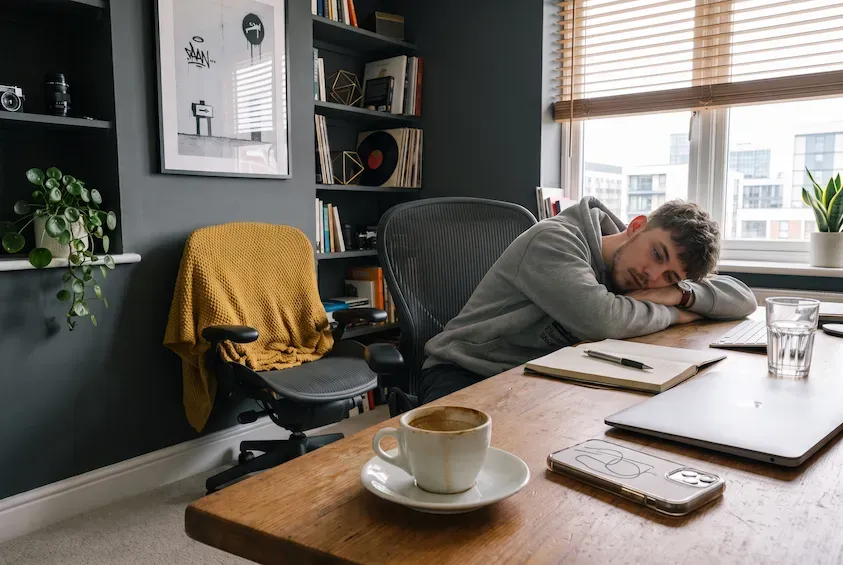
You had the afternoon free. You’d been looking forward to it for a fortnight.
You sat down at two, and by ten past you’d checked your phone, remembered an email, considered whether this was the right way to be spending the time, got up to deal with a cupboard, and sat back down feeling less rested than when you started.
The odd thing about rest is that people who most need it are frequently the worst at it. Not because they don’t want it. Because sitting still turns out to be a thing you can be bad at, and nobody mentions that.
Doing Nothing Is Not the Absence of a Skill
We talk about rest as though it were the default state, the thing that happens when activity stops. Remove the demands and rest floods in.
That isn’t how it works. Stopping is easy. Settling is not, and the gap between the two is where most free afternoons go.
If you’ve spent years running at a certain level of activation, that level doesn’t drop the moment the demands do. It’s still there, looking for somewhere to go, and an empty afternoon gives it nothing to attach to except you.
Which is why unstructured free time can feel worse than being busy. Being busy at least gave the activation a target.
Four Reasons It’s Harder Than It Should Be
Rest has no completion. Everything else you do has a finish: the task is done, the thing is clean, the email is sent. Rest has no such marker, so there’s no moment where you’ve succeeded at it, which for anyone who runs on completing things is deeply unsatisfying. You end an afternoon of rest with nothing to point at.
The activation doesn’t stop when the demands do. Your system stays wound for a while after the winding stops. Sitting down doesn’t discharge it; it just removes the distraction from it, which is why the first ten minutes of rest often feel worse rather than better.
Rest is where the postponed things show up. All day, the unresolved stuff is outrun. In a quiet room there’s nothing between you and it, so the moment you stop, everything you’ve been ahead of catches up. That’s not a sign you’re bad at resting. It’s what stopping does, and it’s a large part of why people avoid it.
It looks like nothing from the outside, including to yourself. Sitting in a chair on a Tuesday afternoon is indistinguishable from avoidance. So it gets postponed until it can be justified, which usually means until you’ve collapsed and it isn’t a choice anymore.
Why the Substitutes Don’t Work
Faced with a gap, the instinct is to fill it with something that resembles rest and isn’t.
Scrolling is the main one, and it’s worth being clear about why it fails. It isn’t restful because your attention is still being asked for constantly: judgments, reactions, small decisions, in a stream with no end. It’s low-effort stimulation, which is a third category, and it’s the one that most reliably produces the “I rested and feel no better” outcome.
Same with anything half-done. Half-watching something while doing admin. Sitting down with your phone in reach. A break that’s really just a slower kind of working. These are all attempts to rest without accepting the uncomfortable part, and the uncomfortable part is where the rest actually is.
Making It Possible
The trick isn’t to try harder at doing nothing. It’s to make it easier to tolerate.
Give it a shape and an end. Twenty minutes, timer set. This solves the no-completion problem: now there’s a finish, and you can succeed at it. Counterintuitively, a bounded rest is easier to fall into than an open-ended one, because you’re not deciding when to stop the whole time.
Expect the first ten minutes to be unpleasant. This is the single most useful thing to know. The itch, the restlessness, the certainty that this is a waste of time: that’s the activation dissipating, and it passes. People quit during it and conclude they can’t rest, when what happened is that they stopped one minute before it worked.
Deal with the incoming thoughts before you start, not during. If the reason you can’t sit still is a list, write the list down first. Five minutes of getting it onto paper buys you a much better twenty minutes afterward.
Don’t require stillness. For a lot of people, and especially after a mentally demanding day, sitting motionless is the hardest possible version. A walk with no destination, cooking something familiar, doing something with your hands: these are rest too, and they’re often more restorative than lying down. Which kind suits which sort of tiredness is worth its own read.
Put the phone somewhere else. Not face down. Another room. Rest with a phone in reach is a rest you’re constantly deciding not to interrupt, which is its own low-level work.
Book it before you need it. Rest taken when you’re already depleted arrives too late to prevent anything and is much harder to settle into. A small amount, deliberately, before you’re empty, is worth more than a large amount afterward.
The Reframe Worth Having
If you’re waiting to have earned it, you’ll always be resting from a deficit rather than maintaining a reserve, and resting from a deficit is the hardest version there is.
The more useful framing is that rest is part of the work rather than the reward for finishing it. Not because that’s a nicer way to think about it, but because it’s the only version that gets it scheduled, and scheduled rest is the only kind that reliably happens.
When It’s Worth Talking to Someone
Difficulty switching off is common and usually about pace and habit rather than anything being wrong with you.
But if you genuinely cannot settle at any point, if quiet moments bring a level of anxiety that’s hard to sit with, if you’re using constant activity to stay ahead of how you feel, or if rest has stopped being enjoyable rather than just difficult, that’s worth raising with a doctor. The same goes if you’re persistently exhausted, flat, or have lost interest in things you used to look forward to.
Being unable to rest is sometimes about a schedule, and sometimes about carrying more than is sustainable. Those are different things and it’s reasonable to want help telling them apart.
If You Take One Thing
Doing nothing is a skill, you’re probably out of practice, and the first ten minutes are meant to feel bad.
Set a timer, write the list down first, put the phone in another room, and sit through the uncomfortable part rather than treating it as proof that rest isn’t for you. It gets easier, and it gets easier faster than you’d think.