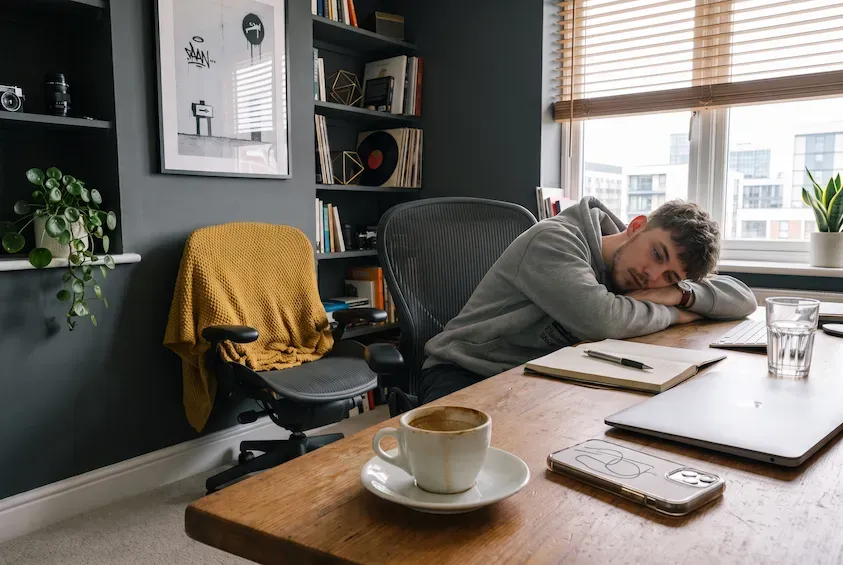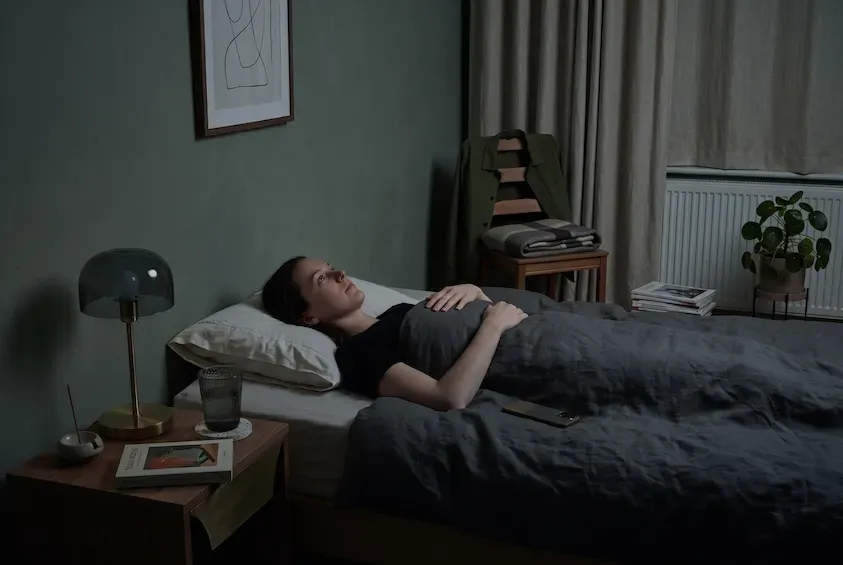
You could barely keep your eyes open at 9 p.m. You dragged yourself through the evening on fumes. You got into bed genuinely, physically exhausted.
And now you’re lying there completely awake, with a body that feels like it’s been run over and a brain that has apparently just clocked in for the day.
It’s one of the more maddening experiences available, partly because it seems like it shouldn’t be possible. If you’re this tired, why won’t it just happen?
Sleepiness and the Ability to Sleep Are Two Different Things
Here’s the distinction that makes the whole thing make sense.
Sleepiness is the pressure to sleep. It builds the longer you’ve been awake, and by late evening it’s high. That’s the part you’re feeling: heavy limbs, sore eyes, the sense of running on empty.
Being able to fall asleep requires something else as well. Your system has to be settled enough to let go. Falling asleep isn’t something you do; it’s something that happens when nothing is preventing it.
Those two run on separate tracks, and they can point in opposite directions. You can have enormous sleep pressure and still be too activated to sleep, which is exactly what “tired but wired” describes. The tiredness is real. It just isn’t sufficient.
What’s Doing the Preventing
Your body has a system for making you alert and ready when something demands it. Heart rate up, attention sharp, muscles primed. It’s useful and it’s supposed to switch on.
The problem is that it doesn’t distinguish well between a physical threat and an unresolved email. Sustained pressure keeps it partly switched on for hours, and it doesn’t wind down just because you’ve decided it’s bedtime and turned the light off.
So you arrive in bed with high sleep pressure and high activation at the same time. The exhaustion is genuine and the alertness is genuine, and they’re produced by different systems that aren’t obliged to agree.
Two things then make it worse.
Bed becomes the place you notice it. All day the activation had somewhere to go. In the dark, with nothing to look at, there’s nothing between you and it.
Trying harder backfires. Once you start monitoring whether you’re falling asleep, you’ve added a task, and a task requires alertness. This is why the harder you try, the more awake you get, and it’s a genuine mechanism rather than bad luck.
Why “Just Relax” Is Useless Advice
Because relaxing isn’t a decision. You can’t will a system to switch off any more than you can decide to stop blushing.
What you can do is stop feeding it, and give it a lower-demand signal to follow instead. That’s what everything below is aimed at. None of it is about trying to sleep.
What Actually Helps
Stop trying to fall asleep. Genuinely. Replace the goal with something you can’t fail at: lying still, in the dark, resting. The pressure of the target is doing a real share of the damage, and dropping it often produces the thing you wanted.
Get up if it’s been a while. If you’re lying there awake and frustrated, staying put teaches your brain that bed is where you lie awake and think. Get up, go to another room, keep the lights low, do something dull, and go back when you feel drowsy rather than when you feel you ought to. Don’t time it with a clock; go by how annoyed you are.
Slow your breathing out. Make the exhale noticeably longer than the inhale and keep going for a few minutes. It’s a small physical lever on how alert you feel, and unlike most of this list it acts on your body rather than your thoughts. Skip it if focusing on your breath makes you feel short of air.
Give the activation somewhere to go earlier in the evening. This is the one that changes the pattern rather than rescuing the night. A deliberate slot in the late afternoon or early evening to write down what’s unfinished and what tomorrow starts with does more than anything you can do at 11 p.m. If your mind is processing the day at midnight, it’s often because midnight is the first chance it’s been given.
Build a wind-down that starts before bed, not in it. Bed is too late to begin. The half hour before it is where the transition actually has to happen: lights lower, demands lower, nothing that requires a decision.
Watch the obvious inputs. Caffeine has a longer tail than you’d assume, and evening light and screens both push alertness in the wrong direction. Both are worth their own attention; the short version is that neither helps here.
Don’t compensate the next night. Going to bed much earlier after a bad night usually means lying awake longer, which reinforces the association you’re trying to break. Keep your wake time fixed and let the pressure rebuild.
When It’s Worth Talking to Someone
Tired but wired is a common and ordinary experience, and it’s usually about circumstance rather than anything being wrong with you.
But if it’s happening most nights over weeks, if it’s not improving when the pressure that caused it lets up, or if you’re anxious about bedtime itself rather than about the things you’re thinking about, that’s worth raising with a doctor. The same goes if low mood or persistent anxiety is part of the picture, or if daytime tiredness is affecting how you function.
There are effective approaches for sleep that’s become a pattern rather than a rough patch, and they work better the earlier they’re started. A stretch of bad nights and something that needs support are different things, and it’s reasonable to want to know which one you’re in.
If You Take One Thing
You aren’t failing at sleeping. You’re carrying two things at once: real exhaustion and real activation, and the second is currently outvoting the first.
Nothing you do in bed at midnight will settle it quickly. What changes the pattern is giving the activation an earlier, deliberate outlet, and taking the pressure off the night itself so that lying there stops being a test you can fail.